45 Acres of Agricultural Land Available for Sale A 45-acre agricultural property is available for sale in Sirikondapalem Village Panchayat, (1/4 km from sarigondapalem Thanda on velgatur road) under Bollapalli Mandal, Vinukonda Sub-Division, Palnadu District. Price: ₹15 Lakhs per Acre (Negotiable) Key Highlights: Excellent investment opportunity for NRIs and investors Water available throughout the year (365 days) Suitable for cultivating 3 crops annually Road Facility. Call 9989977137
The Impact of the War in Ukraine on the Indian Economy Too • Andhra Pradesh to enact law soon for protection of Backward Classes: CM Naidu • BC communities hopeful of political reservations in local body elections • 95% of government jobs are for locals: AP government • APSRTC employees urge EPFO to ensure higher pension, resolve pending issues • బీసీ సంక్షేమ శాఖ నూతన ఆదేశాలు • తెలంగాణలో బీసీ సంక్షేమ పథకాలకు 5,000 కోట్ల నిధులు మంజూరు • 85% బీసీలకు రిజర్వేషన్ డిమాండ్ తీవ్రం • ఆంధ్రప్రదేశ్లో వెనకబడిన వర్గాల జనాభా లెక్కల సర్వే ప్రారంభం • హైదరాబాద్లో భారీ వర్షాలు • బీసీ విద్యార్థులకు ఉచిత కోచింగ్ సెంటర్లు ఏర్పాటు — ప్రభుత్వ ప్రకటన • బీసీ నాయకుల సమావేశంలో కీలక తీర్మానాలు — రాష్ట్రవ్యాప్తంగా ఆందోళన • బీసీ వర్గాలకు 27% రిజర్వేషన్లు అమలు చేయాలని కేంద్రానికి డిమాండ్
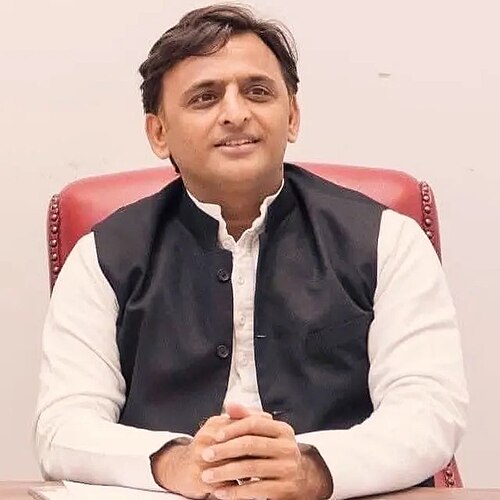
Akhilesh Yadav (pronunciationⓘ; born 1 July 1973)[1] is an Indian politician and national president of the Samajwadi Party, who served as the 20th Chief Minister of Uttar Pradesh from 2012 to 2017.[2] Having assumed the chief minister's office at the age of 38, he is the youngest person to have held the office till date.[3] He is the incumbent Member of Parliament for Kannauj in the 18th Lok Sabha, where he is the parliamentary party leader of Samajwadi Party.[4] Earlier, he was elected as the Member of the Legislative Assembly for Karhal in the 18th Vidhan Sabha,[5][6] before resigning[7] and has also been the Leader of Opposition in the Uttar Pradesh Legislative Assembly from March 2022 to June 2024.
His first significant success in politics was being elected as the Member of the 13th Lok Sabha in the year 2000 (by-poll) for the Kannauj constituency. He is the son of Mulayam Singh Yadav, a veteran Indian politician and the founder of Samajwadi Party who served as Minister of Defence, Government of India and served three terms as the Chief Minister of Uttar Pradesh.
Early life and education
Yadav was born on 1 July 1973 in Saifai, Etawah District, Uttar Pradesh. He was born to Malti Devi and Mulayam Singh Yadav, later Chief minister of Uttar Pradesh.[8] Malti Devi suffered complications while giving birth to Akhilesh which put her in a vegetative state. She died in 2003. With Mulayam Singh Yadav busy making a career in politics, Akhilesh was brought up mostly by his paternal grandparents.
He completed his early education in a local school in Saifai and then one in Etawah town.[9] He was schooled at Dholpur Military School in Dholpur, Rajasthan, then obtained his bachelor's degree in Civil Engineering at the University of Mysore, Karnataka, India.[10]
Political career
Yadav was elected to the 13th Lok Sabha from Kannauj in a by-election in 2000.[11] He was also a member of the Committee on Food, Civil Supplies, and Public Distribution.[12][13] Yadav served as a Member of the Committee on Ethics from 2000 to 2001[14] and in 2004 was elected as a member of the 14th Lok Sabha for a second term. He was at times a member of the following committees: Committee on Urban Development, Committee on Provision of Computers for various departments, Committee on Science and Technology, and Committee on Environment and Forests.
From 2009 to 2012 Yadav was elected and served as a member of the 15th Lok Sabha for a second term. During this period he was a member of the following committees: Member of the Committee on Environment and Forests, Committee on Science and Technology, and the JPC on the 2G spectrum case. On 10 March 2012 he was appointed leader of the Samajwadi Party in Uttar Pradesh. On 15 March 2012, at the age of 38, he became the Chief Minister of Uttar Pradesh, the youngest to hold the office.[15]
In May 2012 Yadav resigned from the Kannauj parliamentary seat to further serve as the Chief Minister of Uttar Pradesh after his party won the Assembly elections.[16] In the same month he became Member of the Uttar Pradesh Legislative council.[17] In the 2017 Assembly elections, the SP-Congress Alliance headed by Yadav was unable to form the government. He submitted his resignation to Governor Ram Naik on 11 March.[18]
The 2019 Indian general elections and 2022 Uttar Pradesh Legislative Assembly elections saw Yadav being elected to the parliament and state assembly simultaneously, with Yadav later retaining his state assembly seat, and thereby submitting his resignation in the Lok Sabha.[19]
In the 2024 Indian general election Yadav was elected to the 18th Lok Sabha from Kannauj.[6]
Chief Minister of Uttar Pradesh
Akhilesh with Tamil Nadu Chief Minister Jayalalithaa in April 2012
Yadav was sworn in as the 20th Chief Minister of Uttar Pradesh on 15 March 2012, aged 38, winning 224 seats in the March 2012 assembly elections.[15] During his tenure, the Agra-Lucknow Expressway, thelongest expressway in India at that time, was inaugurated.[20][21][22] Yadav also launched the "UP100 Police Service",[23] "Women Power Line 1090"[24] and "108 Ambulance Service".[25] Projects like the Lucknow Metro Rail,[26] Lucknow International Ekana Cricket Stadium,[27] Janeshwar Mishra Park (Asia's largest park),[28] Jayaprakash Narayan International Convection Center, IT city were inaugurated.[29] His chief ministerial tenure saw emphasis on setting up Kisan Bazaars and Mandis, introducing social welfare schemes such as Lohiya Awas Yojana, Kanya Vidya Dhan, Kisan Avam Sarvhit Bima Yojana, Pension Yojna and allotting unemployment allowances.[30][29] Between 2012 and 2015, over 15 Lakh laptops were distributed to the 10th and 12th passout students by the Government of Uttar Pradesh, making it one of the largest distribution schemes by any government in the world.[31]
Positions held
Akhilesh Yadav has been elected 1 time as MLA and 5 times as Lok Sabha MP.[32]
# From To Position Party
1. 2000 2004 MP (1st term) in 13th Lok Sabha from Kannauj (by-poll)
SP
2. 2004 2009 MP (2nd term) in 14th Lok Sabha from Kannauj
SP
3. 2009 2012 MP (3rd term) in 15th Lok Sabha from Kannauj (resigned in 2012) and Firozabad (resigned in 2009) SP
4. 2012 2018 MLC (1st term) in Uttar Pradesh Legislative Council
Chief Minister (1st term) in Government of UP (2012–2017) SP
5. 2019 2022 MP (4th term) in 17th Lok Sabha from Azamgarh (resigned in 2022) SP
6. 2022 12 June 2024[33]
MLA (1st term) from Karhal
Leader of the Opposition of Uttar Pradesh Legislative Assembly
SP
7. 2024[34]
Present Member of the 18th Lok Sabha (5th time) from Kannauj
SP
Election history
This section of a biography of a living person does not include any references or sources. Please help by adding reliable sources. Contentious material about living persons that is unsourced or poorly sourced must be removed immediately, especially if potentially libelous or harmful. (September 2025) (Learn how and when to remove this message)
Lok Sabha
Year Constituency Party Votes % Opponent Opponent party Opponent votes % Result Margin %
2000* Kannauj
SP
3,06,054 43.1 Akbar Ahmad Dumpy BSP
2,47,329 34.8 Won 58,725 8.3
2004
4,64,367 61.21 Thakur Rajesh Singh 1,56,994 20.69 Won 3,07,373 40.52
2009
3,56,895 48.1 Mahesh Chandra Verma 1,91,887 25.86 Won 1,65,008 22.24
Firozabad
2,87,011 41.9 S. P. Singh Baghel 2,19,710 32.1 Won 67,301 9.8
2019
Azamgarh
6,21,578 60.04 Dinesh Lal Yadav 'Nirahua' BJP
3,61,704 35.1 Won 2,59,874 24.94
2024
Kannauj
6,42,292 52.74 Subrat Pathak 4,71,370 38.71 Won 1,70,922 14.03
• (*) denotes by-election
Member of Legislative Assembly (Uttar Pradesh)
Year Constituency Party Votes % Opponent Opponent party Opponent votes % Result Margin %
2022
Karhal
SP
148,196 60.12 Prof. S.P. Singh Baghel BJP
80,692 32.74 Won 67,504 27.38
Personal life
See also: Political families of Uttar Pradesh
Akhilesh Yadav is married to Dimple Yadav, a Member of Parliament. The couple has three children; two daughters: Aditi and Tina, and a son, Arjun. Akhilesh is a civil engineer, agriculturist, and socio-political worker. He has a keen interest in sports, mainly football and cricket. His favourite pastimes are reading, listening to music, and watching films.[35]
Since Yadav became chief minister, his family was divided into two feuding groups, one siding with him and the other with his uncle Shivpal Singh Yadav. Akhilesh had the support of his father's cousin, Ram Gopal Yadav, while Shivpal later founded his own political party, the Pragatisheel Samajwadi Party (Lohia), which ahead of 2022 elections again merged with Samajwadi Party, with Shivpal being elected as an MLA on a Samajwadi Party ticket.
Member of Parliament, Lok Sabha
Incumbent
Assumed office
4 June 2024
Preceded by Subrat Pathak
Constituency Kannauj, Uttar Pradesh
In office
30 May 2019 – 22 March 2022
Preceded by Mulayam Singh Yadav
Succeeded by Dinesh Lal Yadav
Constituency Azamgarh, Uttar Pradesh
In office
25 February 2000 – 2 May 2012
Preceded by Mulayam Singh Yadav
Succeeded by Dimple Yadav
Constituency Kannauj, Uttar Pradesh
Leader of Samajwadi Party in Lok Sabha
Incumbent
Assumed office
9 June 2024
Deputy Babu Singh Kushwaha
Preceded by S. T. Hasan
2nd President of the Samajwadi Party
Incumbent
Assumed office
1 January 2017
Guidance Leader Mulayam Singh Yadav (till October 2022)
Preceded by Mulayam Singh Yadav
32nd Leader of the Opposition in Uttar Pradesh Legislative Assembly
In office
26 March 2022 – 11 June 2024
Chief Minister Yogi Adityanath
Preceded by Ram Govind Chaudhary
Succeeded by Mata Prasad Pandey
Member of Uttar Pradesh Legislative Assembly
In office
10 March 2022 – 11 June 2024
Preceded by Sobaran Singh Yadav
Succeeded by Tej Pratap Singh Yadav
Constituency Karhal
20th Chief Minister of Uttar Pradesh
In office
15 March 2012 – 19 March 2017
Governor Aziz Qureshi
Ram Naik
Ministry & Departments • Home and Confidential
• Appointment and Personnel
• Finance
• Energy
• Excise
• Higher Education
• Secondary Education
• Housing
• Sugar & Cane Development
• Industrial Development
• General Administration
• Other departments not allocated to a Minister.
Preceded by Kumari Mayawati
Succeeded by Yogi Adityanath
Member of Uttar Pradesh Legislative Council
In office
6 May 2012 – 5 May 2018
Preceded by Kashinath Yadav
Succeeded by Vijay Bahadur Pathak
Constituency Elected by the MLAs
Personal details
Born 1 July 1973 (age 53)
Saifai, Uttar Pradesh, India
Party
Samajwadi Party
Spouse Dimple Rawat
(m. 1999)
Relations Shivpal Singh Yadav (uncle)
Children 3
Parent • Mulayam Singh Yadav (father)
Education University of Mysore (B.E.)
Profession • Politician
• civil engineer
Babu Singh Kushwaha
MPs(LS)
📍 Uttar Pradesh
Jan Adhikar Party
🗓️ 30 July 2024 - present
Babu Singh Kushwaha (born 7 May 1966) is an Indian politician from Uttar Pradesh, serving as chief of the Jan Adhikar Party and former Family Welfare Minister in the Uttar Pradesh government under Mayawati. He was also one of Behenji’s trusted backroom boys, who besides working at the grassroots looked after the party’s administrative affairs. In the 2024 Indian general election, he won from the Jaunpur Lok Sabha constituency on a Samajwadi Party ticket, becoming a member of Lok Sabha for the first time.[1][2]
Background
Kushwaha belongs to a farming family in Pakhrauli village of Banda district, and graduated in 1985. After this, he started his life by putting a dump in Atarra. In April 1988, he came in contact with BSP founder Kanshi Ram. Kanshi Ram called him to Delhi.[3]
Within six months, he was promoted and sent to do organisation work in the Lucknow office. He became the District President of Banda in 1993. In 2003, he was made the Minister of Panchayati Raj in the BSP government.[3]
In 2007, when BSP came to power with an absolute majority, Kushwaha was appointed to important departments like minerals, appointments, and cooperatives. When the Department of Family Welfare was formed, this department was also handed over to him.[3] He was one of the three pillars of the Bahujan Samaj Party when Mayawati was at the peak of her political career along with Swami Prasad Maurya and Nasimuddin Siddiqui.[4]
Political journey
Kushwaha had been a member of Bahujan Samaj Party for 27 years. He was for years perceived as the closest to Mayawati. He was a member of the Uttar Pradesh Legislative Council and was also appointed as a cabinet minister twice.[5] Kushwaha was the second most powerful person in the Bahujan Samaj Party.[6] After the successive murders of two medical officers in Lucknow he blew the lid off the giant National Rural Health Mission scam. He had held the portfolio of the Family Welfare, Mining, Panchayati Raj and several other departments before resigning.[7]
Kushwaha joined the BJP in the presence of senior leaders Vinay Katiyar and Surya Pratap Shahi, but his induction resulted in voices of dissent in the party, after which he wrote a letter to BJP national president Nitin Gadkari requesting him to suspend his membership until proven innocent. Kushwaha formed the political party Jan Adhikar Party in 2016.[7]
His wife Shivkanya Kushwaha contested for Ghazipur Lok Sabha constituency from the Samajwadi Party (SP) in 2014. She placed second, receiving 27.82% of votes, and losing by 32,452 votes to Manoj Sinha of BJP.[8]
Jan Adhikar Party
Babu Singh Kushwaha founded the Jan Adhikar party on 9 December 2016, with the ideology to provide equal rights to all sections of society according to their population. The party aims to empower all the deprived, exploited, labourers, farmers, poor, and women and to provide them with their rights. The main objective of the party is to release the caste census report and to give a share in all the resources of the country to all the sections in proportion to the population.[9]
His Jan Adhikar Party was a part of the coalition Bhagidari Parivartan Morcha in the 2022 Uttar Pradesh Legislative Assembly elections. The party did not manage to win any seats in the elections of Uttar Pradesh.[10][11]
2024 General elections
Kushwaha won the 2024 general election from Jaunpur Lok Sabha Constituency on Samajwadi Party Symbol.[12] His Jan Adhikar Party is a part of the INDIA Alliance .[13][14]
After his victory, it was reported that despite being supported by muscleman politician Dhananjay Singh, Bharatiya Janata Party candidate Kripa Shankar Singh was unable to take an edge over Kushwaha. He was defeated by over 99,000 votes. Sitting member of parliament and Bahujan Samaj Party candidate Shyam Singh Yadav finished in third position.[15]
Soon after his election to Lok Sabha, he was made the deputy leader of Samajwadi Party in the Lok Sabha by Akhilesh Yadav.
Deputy Leader, Samajwadi Party in Lok Sabha
Incumbent
Assumed office
30 July 2024
Leader Akhilesh Yadav
Member of Parliament, Lok Sabha
Incumbent
Assumed office
4 June 2024
Preceded by Shyam Singh Yadav
Constituency Jaunpur
Cabinet Minister
Government of Uttar Pradesh
In office
13 May 2007 – 8 April 2011
Chief Minister Mayawati
Ministry & Department's • Family Welfare.
• Panchayati Raj.
• Mining.
• Geology.
• Cooperative.
In office
11 October 2002 – 28 May 2003
Chief Minister Mayawati
Ministry & Department's • Mining.
• Geology.
Member of the Uttar Pradesh Legislative Council
In office
6 May 2000 – 5 May 2012
Constituency elected by MLA'S
Personal details
Born 7 May 1966 (age 60)
Pakhrauli, Uttar Pradesh, India
Party
Jan Adhikar Party (2016-Present)
Other political
affiliations Bahujan Samaj Party
(1984-2011)
I.N.D.I.A.
(2024-Present)
Spouse Shivkanya Kushwaha
Children 4
Profession Politician
Website https://www.janadhikarparty.org/
Basavaraj Bommai
MPs(LS)
📍 Haveri, Karnataka
Karnataka
🗓️ 4 June 2024 - Present
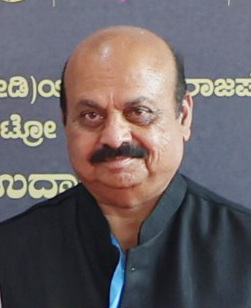
Basavaraj Somappa Bommai // ⓘ (born 28 January 1960) is an Indian politician and engineer who is currently serving as the Lok Sabha MP of Haveri and previously served as the 17th Chief Minister of Karnataka from 18 July 2021 to 19 May 2023. He formerly served as the Interim Leader of the Opposition in Karnataka Legislative Assembly as a member of the Bharatiya Janata Party and he was former member of the Janata Dal and Janata Dal (United). He was a Member of the Legislative Assembly in the legislature of Karnataka for Shiggaon, from where he has been elected four times since 2008. Between 1998 and 2008, he was a member of the Karnataka Legislative Council from Dharwad local authorities. He served as Minister for Water Resources and major and medium irrigation from 2008 to 2013, Home Affairs, Law and Parliamentary Affairs and Cooperation between 2019 and 2021 minister in charge of Haveri and Udupi districts from 2019 to 2021.[1]
In July 2022, Bommai became only the second person from BJP to complete one year as chief minister of the state.[2] During his tenure he was called the "Common Man − CM" by the media and his followers.[3][4][5] Bommai is the son of the former Chief Minister of Karnataka and Union Minister of Human Resource Development, S. R. Bommai, who is widely remembered as the champion for the landmark judgment of the Supreme Court of India, S. R. Bommai v. Union of India, considered one of the most quoted verdicts in the country's political history.[6][7][8] Basavaraj Bommai and his father are the second father and son duo after H. D. Devegowda and H. D. Kumaraswamy to become the Chief Ministers of Karnataka, a testament to prevalent nepotism in politics.[9] In March 2024, he was announced as the BJP candidate for the Haveri Lok Sabha constituency in the 2024 General Elections.[10]
Personal life
Bommai was born on 28 January 1960 to former Chief Minister S. R. Bommai and his wife Gangamma Bommai in Hubli, Mysore State (present-day Karnataka).[11] Bommai is a Mechanical Engineering graduate from KLE Technological University, and started his career with Tata Motors in Pune. He is also an agriculturist and industrialist by profession. He is married to Chennamma and has two children.[12] He belongs to Sadar Lingayat community.[13]
Early political career
BS Bommai started his political career as a member of the Janata Dal in 1992. While in Janata Dal, he worked with senior politicians of the Janata Dal like H. D. Deve Gowda and Ramakrishna Hegde.[14] He later also served as a political secretary to then Chief Minister J. H. Patel.[15]
Bommai contested the 1994 Karnataka legislative assembly elections from Hubli Rural constituency as a member of the Janata Dal. However, he lost the election to Jagadish Shettar of the Bharatiya Janata Party.[16]
Bommai was elected as a member of the Karnataka Legislative Council in 1998 from Dharwad local authorities constituency as a member Janata Dal. After the dissolution of the Janata Dal, he joined the Janata Dal (United). Later in 2004, he was re-elected from Dharwad local authorities constituency as a member Janata Dal (United).[17]
He quit the Janata Dal (United) in February 2008 and later joined the Bharatiya Janata Party in the same month of the year.[18]
Rise in state politics
In the 2008 Karnataka state elections, he was elected to the Karnataka Legislative Assembly from Shiggaon constituency in Haveri district. He was considered as a close aide of the then Chief Minister B. S. Yediyurappa.[19]
Cabinet minister of Karnataka
Karnataka Minister for Water Resources, Shri Basavaraj Bommai called on the Union Minister for Water Resources, Prof. Saifuddin Soz, in New Delhi on October 17, 2008
In February 2008, he left Janata Dal (United) and joined Bharatiya Janata Party. The same year he was elected to Karnataka Legislative Assembly from Shiggaon constituency. Between 2008 and 2013 Bommai served as Minister for Water Resources under Chief Ministers B. S. Yediyurappa, Sadananda Gowda and Jagadish Shettar.
Bommai is widely acclaimed for his contributions to irrigation schemes and deep knowledge regarding irrigation matters in Karnataka. He is also credited with implementing India's first 100% piped irrigation project at Shiggaon in Haveri district of Karnataka.[20][21]
In the Fourth Yediyurappa ministry he held key ministerial portfolios, serving as Minister of State for Home Affairs, Law and Parliamentary Affairs and as Minister for Cooperation. He also served as Minister in charge of Haveri and Udupi districts.
In December 2019, a protest against the Citizenship Amendment Act in Mangalore turned into violence and riots when a mob of protesters attempted to lay siege to the Mangalore North police station and tried to attack cops. Section 144 was imposed by the Police department around the areas of the riots. Later two people were killed in Mangalore in police firing after protests against the Citizenship Amendment Act turned too violent.[22] The Home Minister Bommai set-up a team and ordered probe into this matter. Over 60 people were identified and detained by the cops after the December 19th violence. The Karnataka government also suspended mobile Internet services in Dakshina Kannada district in Mangaluru for few hours in the wake of violence.[23][24]
After the 2020 Bangalore riots, then Home Minister Bommai ordered a detailed investigation and assured compensation for damaged property be forcibly provided by known participants in the riots, a policy proposed by Yogi Adityanath-led Uttar Pradesh following anti-CAA protests there.[25]
During the second wave of the COVID-19 pandemic in Karnataka, Bommai, as Home Minister, imposed strict lockdown regulations.[26] Bommai converted his residence at Shiggaon in Haveri district into a Covid Care Centre that could accommodate up to 50 patients, to reduce the burden on the Shiggaon taluk hospital. He also appointed doctors and medical staff to take care of the patients along with oxygen concentrators.[27][28]
Chief Minister of Karnataka
See also: Basavaraj Bommai ministry
Chief Minister Basavarj Bommai, meets the Union Defence Minister Rajnath Singh and Minister of State New & Renewable Energy & Chemicals and Fertilizers Bhagwanth Khuba in New Delhi.
B. S. Yediyurappa resigned as Chief Minister on 26 July 2021, on the second anniversary of his term. Dharmendra Pradhan and G. Kishan Reddy were sent by the national leadership of the BJP to carry out the selection of the next chief minister. On 27 July 2021, Bommai was elected to the post.[29][30][31] He was sworn in the next day as the 23rd Chief Minister of Karnataka, becoming the fourth chief minister from the Bharatiya Janata Party in the state.[32] On his very first day as the Chief Minister, after the cabinet meet he announced scholarships for higher education to farmers' children. He also increased the pensions of widows, physically challenged and senior citizens of the state.[33][34]
In August 2021, under Basavaraj Bommai's administration Karnataka became the first state in the country to implement the National Education Policy 2020.[35]
Bommai, with Prime Minister Modi during his visit to Bengaluru in June 2022
In September 2021, Basavaraj Bommai's administration faced criticism over the demolition of local temples that were not approved by the government, following a Supreme Court order. Due to public outcry, he ordered a halt on the demolition of temples.[36][37] [38]
Bommai revived Pratibimba − the Chief Minister's Dashboard, an online portal to review developmental works designed in line with that of Prime Minister's Office in October 2021.[39][40]
Bommai's government passed the Anti-Conversion bill (The Karnataka Right to Freedom of Religion Bill) in December 2021, which prohibits forcible conversion of religion from one to another, by fraud, allurement or marriage. The bill provided some exemption if one needed to re-convert back to his/her immediate previous religion.[41] The oppositions staged various protests condemning this bill, both in the floor of the house and in various places around the streets.[42][43]
Bommai presented his maiden Karnataka state budget with an outlay of 2.6 lakh crores in March 2022.[44] The main highlights included flow of money of around 30,000 crores for construction of fly-overs, under-pass, highways, Namma Metro and hospitals in Bangalore; 11,500 crores to inland transport; 9,500 crores to the development of Mekedatu project, Upper Krishna Project, Upper Bhadra River and Arkavathi River projects.[45][46]
In May 2022, Bommai visited the World Economic Forum at Davos, Switzerland to bring in investments to the state. His main concerns was to attract the investors to the Global Investors meet held in Bangalore during the time of November.[47] Bommai stated that he has inked MOUs with LuLu Group International and ReNew Power companies for Rs 52,000 crores investments over the next seven years.[48][49]
In October 2022, Bommai and former chief minister B S Yediyurappa launched the 'Jan Sankalp Yatra', party's travel across the state starting from the district of Raichur. It was termed to be started to counter the opposition's 'Bharat Jodo Yatra' going around in the state.[50]
In November 2022, Bommai's government inaugurated "The Statue of Prosperity" − a 108 feet tall statue of the city founder Kempe Gowda in Kempegowda International Airport of Bangalore, in the presence of Prime Minister of India Narendra Modi and other delegates. This statue entered the World Book of records as the World's tallest bronze statue of a city founder.[51]
In February 2023, Bommai along with Prime Minister Narendra Modi, inaugurated Asia's largest helicopter manufacturing facility, HAL in Gubbi taluk of Tumkur. The facility has production, testing and deployment infrastructure facilities spread over an area of 615 acres of land. This organisation is said to boost the employments in the state and also strengthen the defense sector in the country.[52]
In March 2023, his government passed the controversial Factories (Karnataka Amendment) Act, 2023 increasing work hours limit from 9 to 12 in a day in factories, allowing night shift for women and set the maximum work hours at 48 per week. Allowable overtime hours were also increased from 75 to 145 for three month period. The government also reduced minimum wages in the dyeing, printing, silk and textile industries. Bahutva Karnataka, a coalition of progressive organisations, accused the government of introducing laws to deny basic rights to workers.[53]
In the same month, his government inaugurated the "Bengaluru − Mysuru 10 lane Highway" in the presence of Prime Minister Narendra Modi, that also connected Ramanagara, Channapatna, Mandya, Maddur and other parts along the way. This project was said to reduce time of travel from 3 hours to 75 minutes and also conserve energy usage.[54][55]
In the last cabinet meeting held by the end of March 2023, Bommai's government announced significant changes regarding the reservation for castes in government jobs and education. The 4% OBC quota provided to Muslims under 2B, were scrapped and moved to 10% reservation under the Economically Weaker Sections. The same were extended to Vokkaligas and Lingayats under new categories of 2C and 2D. This also led to protests by various communities across parts of the states and also faced opposition from other parties and organizations.[56][57]
Challenges
Bommai's government was accused by various Christian groups for the 2021 anti-Christian violence in Karnataka, following the implementation of his Karnataka Protection of Right to Freedom of Religion Act or the anti-conversion law by his government.[58][59][60]
The Archbishop of Bengaluru, Most Rev. Peter Machado accused the Chief Minister for providing tacit sanction to vigilantes to extend targeted attacks on minorities, particular Christian communities in Karnataka.[61][62]
In February 2022, a controversy over hijabs in educational institutions started in Udupi, followed by various protests in the state. Bommai's Government issued an order stating that the uniforms mandated by the state government, the school managements or college development committees must be worn compulsorily. Further on 15 March, the High Court of Karnataka upheld the government's decision of not allowing any religious symbols and to follow the rules of uniformity, in educational institutions.[63][64]
The Karnataka PSI Scam, which is an entrance exam to fill 545 vacant seats of police sub-inspector post, was conducted in October 2021. Suspicions arose about some candidates allegedly using fraudulent means to score well in the exam. And these malpractices were supported by various higher officials, police officers and recruitment officials who were allegedly bribed with money.[65] This included the allotment of seats, ranks and positions to those students who brought in money. This led to a political storm, and a CID enquiry was instigated. Various political leaders from all parties, IPS and IAS officers and DCs were held in custody with the enquiry subsiding on.[66][67]
A contractor named Santhosh, committed suicide allegedly stating that he was harassed by the cabinet minister K. S. Eshwarappa, to provide him 40% commission of the grants provided for various construction and development projects.[68] This led to various protests across the state by the opposition demanding the resignation of the minister. Bommai received his resignation couple days later, and initiated a CID enquiry into the issue. The opposition branded the cabinet as "40% government".[69] However Eshwarappa was provided a clean chit, at the end of the trial by the investigative agencies.[70]
The state was throbbed with series of killings in coastal Karnataka in July 2022. The Murder of a BJP worker Praveen Nettaru led to fierce protests across the state against the government, and led to resignation of thousands of members from the party.[71] Muslim bodies slammed Bommai for his partial treatment in the serial killing in the district of Dakshina Kannada, as his compensation for the Hindu Victim was different and Muslim Victim was different plus the agencies handling the cases were different.[72][73]
The opposition parties shared and published a scannable 'PayCM' posters, with Bommai's face on it. These posters were stuck on walls of streets and the government was accused of corruptions, commissions and briberies, once the QR codes on the posters were scanned. The BJP called it cheap politics, and cases were filed against members of Congress, for sticking up of posters in public places, which is prohibited in the state.[74][75]
According to the National Family Health Survey 5 (NFHS-5) for the year 2019–21, 35% children were stunted and 33% were overweight due to food security schemes not being properly implemented and communal groups disrupting access to nutrition.[76] Environment conservation was another challenge as depletion threats are looming on many rivers like Arkavathy, Vrishabhavathi, and Pinakini.[76]
2023 Assembly elections
In the 2023 Karnataka Legislative Elections, as the chief minister he won from the Shiggaon constituency by a margin of 33,000 votes.[77] However, his party lost the majority in the assembly and Bommai conceded his party's defeat and stated "BJP has not been able to make the mark" and said would come back stronger in the successive Lok Sabha elections.[78] He tendered his resignation as the chief minister of the state to the Governor Thawar Chand Gehlot on 13 May 2023 and served as a caretaker chief minister until the next government was formed.[79]
2024 Lok Sabha Elections
He won as the BJP candidate from the Haveri Loksabha constituency in the 2024 General Elections.[80]
Elections Contested
Karnataka Legislative Assembly
Year Constituency Party Votes % Opponent Opponent Party Opponent Votes % Result Margin %
2023
Shiggaon
BJP
100,016 54.95 Yasir Ahmed Khan Pathan
INC
64,038 35.18 Won 35,978 19.77
2018
83,868 49.02 Syed Azeempeer Khadri
74,603 43.69 Won 9,265 5.45
2013
73,007 48.64 63,504 42.31 Won 9,503 6.33
2008
63,780 51.76 50,918 41.32 Won 12,862 10.44
Lok Sabha
Year Constituency Party Votes % Opponent Opponent Party Opponent Votes % Result Margin %
2024
Haveri
BJP
705,538 50.55 Anandswamy Gaddadevarmath INC
662,025 47.43 Won 43,513
Member of Parliament, Lok Sabha
Incumbent
Assumed office
4 June 2024
Preceded by Shivkumar Udasi
Constituency Haveri, Karnataka
Acting Leader of Opposition in Karnataka Legislative Assembly
In office
20 May 2023 – 17 November 2023
Chief Minister
Siddaramaiah
Preceded by Siddaramaiah
Succeeded by R. Ashoka
17th Chief Minister of Karnataka
In office
28 July 2021 – 20 May 2023
Governor Thawar Chand Gehlot
Preceded by B. S. Yediyurappa
Succeeded by Siddaramaiah
Minister of Law & Legislative Affairs of Karnataka
In office
21 January 2021 – 26 July 2021
Chief Minister
B. S. Yediyurappa
Preceded by J. C. Madhuswamy
Succeeded by J. C. Madhuswamy
Minister of Home Affairs of Karnataka
In office
20 August 2019 – 26 July 2021
Chief Minister
B. S. Yediyurappa
Preceded by M. B. Patil
Succeeded by Araga Jnanendra
Minister of Cooperation of Karnataka
In office
27 September 2019 – 10 February 2020
Chief Minister
B. S. Yediyurappa
Preceded by Bandeppa Kashempur
Succeeded by S. T. Somashekhar
Minister of Major & Medium Irrigation of Karnataka
In office
7 June 2008 – 13 May 2013
Chief Minister
B. S. Yediyurappa
Sadananda Gowda
Jagadish Shettar
Preceded by K. S. Eshwarappa
Succeeded by M. B. Patil
Member of Karnataka Legislative Assembly
In office
25 May 2008 – 15 June 2024
Preceded by Sindhura Rajashekhar
Succeeded by Yasir Ahmed Khan Pathan
Constituency Shiggaon
In office
6 January 1998 – 17 April 2008
Succeeded by Shivaraj Sajjanar
Constituency Dharwad Local Authorities
Personal details
Born 28 January 1960 (age 66)
Hubli, Mysore State, India
(present-day Hubballi, Karnataka)
Party
Bharatiya Janata Party (since 2008)
Other political
affiliations Janata Dal (United) (2004–2008)
Janata Dal (1992–2004)
Spouse Chennamma
Children 2 (including Bharath Basavaraja Bommai)
Parent • S. R. Bommai (father)
Education B.E
Alma mater
KLE Technological University
Cabinet Basavaraj Bommai ministry
Chandraprakash Choudhary
MPs(LS)
📍 Jharkhand
AJSU
🗓️ 2024-present
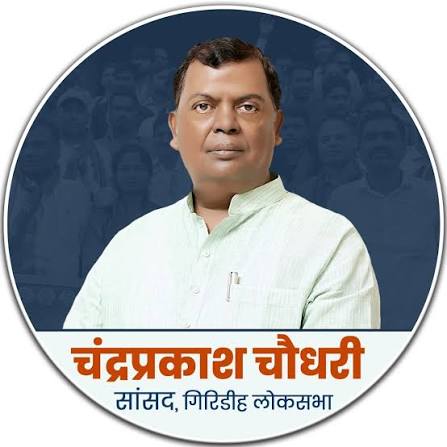
Chandra Prakash Choudhary (born 18 August 1967; Hindi pronunciation: [t͡ʃən̪d̪ɾə pɾəkaːʃ t͡ʃɔːd̪ʱ.ɾiː]) is an Indian politician and member of Lok Sabha from Giridih constituency.[1] He is a senior vice president of AJSU party and a 3 time MLA from Ramgarh Vidhan Sabha constituency (2005–19). He has also served as a Minister for Water Resources in the Raghubar Das government.
He is a Kurmi leader and hails from Sandi village located in Chitarpur block of Ramgarh district.[2][3] He has close ties with AJSU President Sudesh Mahto. Both his wife Sunita Choudhary and close associate Lambodar Mahto are Ex MLAs from Jharkhand legislative assembly.
Positions held
Chandra Prakash Choudhary has held several important positions throughout his political career. He was elected to the 18th Lok Sabha in June 2024 and has since served as a Member of the Committee on Labour, Textiles, and Skill Development since 26 September 2024. He is also a Member of the Consultative Committee for the Ministry of Steel.
From 9 October 2019, he has been a Member of the Joint Committee on Salaries and Allowances of Members of Parliament and a Member of the Standing Committee on Water Resources since 13 September 2019. He was elected to the 17th Lok Sabha in May 2019.
At the state level, Chandra Prakash Choudhary served as the Speaker of the Jharkhand Legislative Assembly from 2013 to 2014. He held the position of Cabinet Minister in the Government of Jharkhand from 2005 to 2013 and again from 2014 to 2019. He was a Member of the Jharkhand Legislative Assembly for three terms between 2005 and 2019.
Member of Parliament, Lok Sabha
Incumbent
Assumed office
23 May 2019
Preceded by Ravindra Kumar Pandey
Constituency Giridih
Senior Vice President of AJSU party
President Sudesh Mahato
Preceded by position established
Minister of Water Resources Minister of Drinking Water & Sanitation, Jharkhand
In office
28 December 2014 – 4 June 2019
Chief Minister
Raghubar Das
Minister of Disaster Management, Jharkhand
In office
28 December 2014 – 20 February 2015
Chief Minister
Raghubar Das
Succeeded by Chandreshwar Prasad Singh
Minister of Emergency department, Jharkhand
In office
11 September 2010 – 8 January 2013
Chief Minister
Arjun Munda
Member of Legislative Assembly, Jharkhand
In office
27 February 2005 – 23 May 2019
Preceded by Babulal Marandi
Succeeded by Mamta Devi
Constituency Ramgarh
Personal details
Born 18 August 1967 (age 58)
Chitarpur, Jharkhand, India
Party
All Jharkhand Students Union
Children Sooraj Choudhary, Kumar Piyush, Sonal Priya Choudhary
Occupation Politician
Hanuman Beniwal
MPs(LS)
📍 Rajasthan
RLP
🗓️ 2024 – present
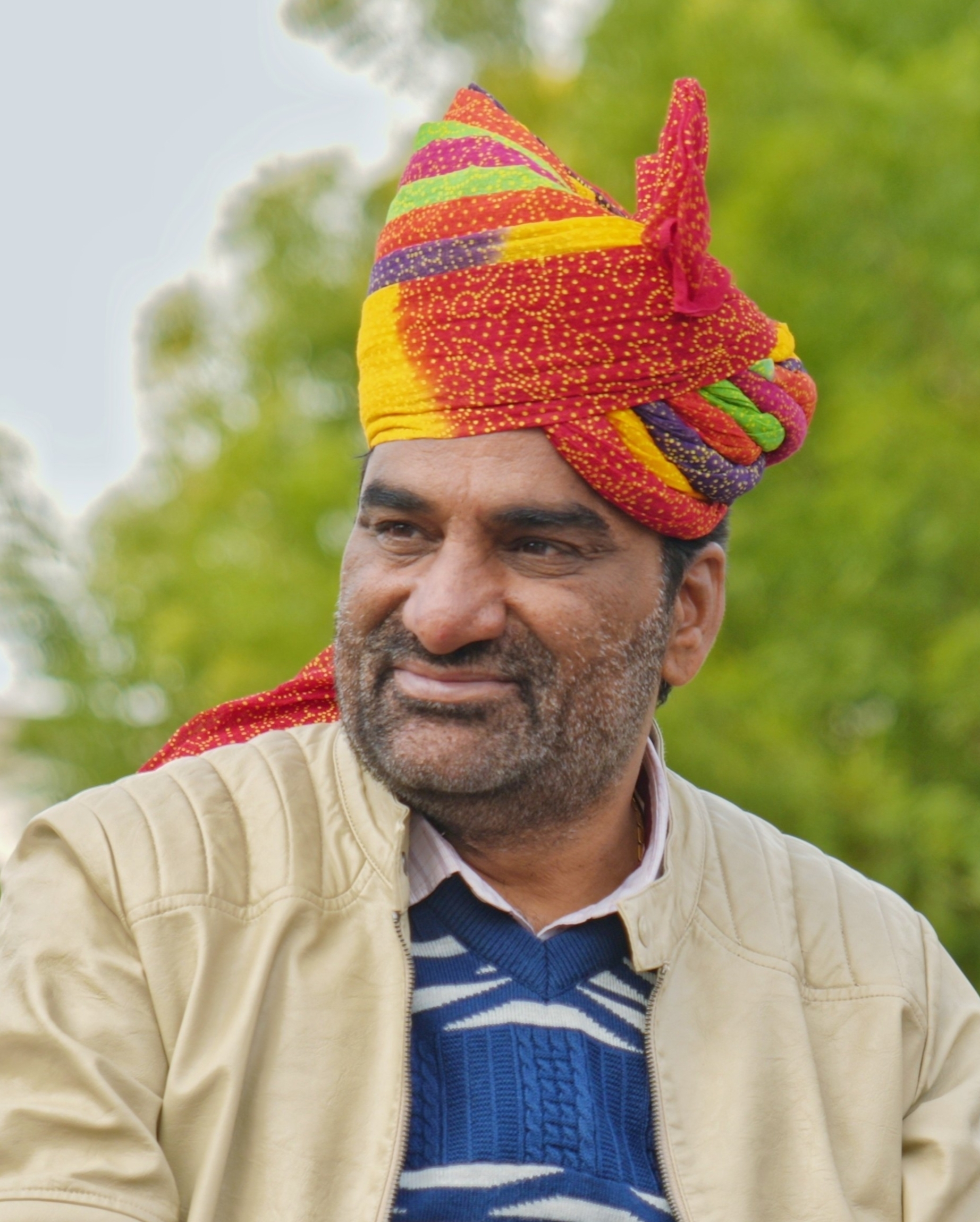
Hanuman Beniwal (Hindi pronunciation: [ɦənʊˈmaːn beːˈɳiːʋaːl] ⓘ; born 2 March 1972) is an Indian politician and founder of the Rashtriya Loktantrik Party (RLP). Beniwal has served as a Member of Parliament in the Lok Sabha from Nagaur since 2019. He is the founder and national convener of the Rashtriya Loktantrik Party, the third political party of Rajasthan besides the Indian National Congress and the Bharatiya Janata Party. He has been elected to the Rajasthan Legislative Assembly for four-terms from the Khinvsar constituency since 2008.[2][3]
His political career began during his student life as the president of the Rajasthan University Student Union. He later entered the Politics of Rajasthan with the Bharatiya Janata Party in 2008. Beniwal later formed the Rashtriya Loktantrik Party, after accusing BJP leaders of corruption.[4]
Beniwal is an agrarian rights activist. He resigned from the parliamentary committees and National Democratic Alliance (NDA) in opposition to the 2020 Indian agriculture acts.[5] He has led various protests on public issues, most notably against the Rajasthan Public Service Commission (RPSC),[6] over paper leaks, illegal sand mining in the state,[7] and the central government’s Agnipath military recruitment scheme.[8]
Early life
Beniwal was born on 2 March 1972 to Ramdev Beniwal and Mohini Devi in Barangaon village of Nagaur district in Rajasthan.[9] His father was a two-term member of the Rajasthan Legislative Assembly from Mundwa constituency.[10] He belongs to the Hindu Jat community.[11] He acquired a Bachelor of Arts degree from University of Rajasthan in 1993 and then he obtained a Bachelor of Laws degree in 1998.[12]
Early political career (1994–2008)
Student politics
Beniwal began his political career as a student leader at Rajasthan University. In 1994, Beniwal was elected president of Maharaja College, Jaipur student union, a position he held again in 1995. Beniwal became president of the Law College, Jaipur in 1996.[13]
During the 1996 Rajasthan University student union elections, Beniwal and Mahendra Chaudhary opposed a proposed university shutdown by opposition groups. Later, a confrontation at the university gate led to a clash with police, resulting in a lathicharge. Beniwal and over a dozen students were arrested and detained at Jaipur Central Jail. They were subsequently released by the state government. [14][15]
In September 1997, following a gang rape at JC Bose Hostel, public outrage grew in Jaipur.[16] Beniwal led protests against the incident, gaining support among students. Beniwal contested and won the 1997 Rajasthan University student union elections as an independent candidate.[17]
During his tenure as student union president, Beniwal advocated for a five percent bonus in marks for rural students during Rajasthan University's admissions, addressing disparities in educational resources. After winning the Rajasthan university elections, Beniwal launched a movement for this, leading to clashes with police and his arrest during a protest, following the protests, the university implemented the five percent bonus marks policy for rural students.[18][15]
Jeevan godara case (2006)
In 2006, Beniwal and Ruparam Dudi led protests demanding justice for Jeevan Ram Godara, a student leader from Rajasthan, who was murdered along with his friend Harphool Jat by the gang of Anandpal Singh.[19] Their protests sought a fair investigation into the killings. After prolonged legal proceedings, on 12 March 2018, the Didwana ADJ Court sentenced Sanjay Pandey, Datar Singh, and Srivallabh to life imprisonment for their role in the double murder.[20]
State politics (2008–present)
In 2003, Beniwal contested his first Rajasthan Assembly election from the Mundwa constituency on an Indian National Lok Dal (INLD) ticket.[21] This constituency held personal significance, as it was previously represented by his father, Ramdev Beniwal, who was elected twice in 1977 and 1985. During the 2003 campaign, INLD leader and the then chief minister of Haryana, Om Prakash Chautala campaigned in Rajasthan to support Beniwal.[22] Despite securing 35,724 votes, Beniwal was defeated by the Bharatiya Janata Party (BJP) candidate. Beniwal was first elected to 2008 Rajasthan Assembly election from Khinwsar constituency as a BJP candidate.[23]
Tensions with the Bharatiya Janata Party leadership (2010s)
In the early 2010s, tensions escalated between Beniwal and the Bharatiya Janata Party (BJP) leadership in Rajasthan. Beniwal accused senior party members, including then-opposition leader Vasundhara Raje and Rajendra Rathore, of corruption, alleging they maintained illicit ties with Congress chief minister Ashok Gehlot.[24] These allegations were made during a period of internal BJP factionalism in Rajasthan ahead of the 2013 state elections. The BJP leadership deemed Beniwals statements as an act of indiscipline, leading to his suspension and eventual expulsion from the Bharatiya Janata Party. No independent investigation substantiated Beniwals claims, and neither Vasundhara Raje nor Rajendra Rathore faced legal action based on these allegations. The controversy prompted Beniwals to form the Rashtriya Loktantrik Party (RLP).[25]
After Beniwal's suspension from the Bharatiya Janata Party, he contested the 2013 assembly elections as an independent candidate and won with a margin of 23,020 votes, securing his seat in assembly for second term.[26] During his second term, Beniwal continued to target both BJP and Congress leaders, accusing them of corruption and neglecting farmers' issues. Beniwal also demanded a CBI inquiry against state cabinet minister Yunus Khan, alleging that Khan aided gangster Anandpal Singh in escaping police custody in exchange for electoral support in 2013. However, no evidence was presented to support Beniwal's claims, and the CBI inquiry he demanded did not materialise. Khan denied the allegations, and no legal proceedings were initiated against him in connection with this matter.[27]
On 23 September 2015, Beniwal was attacked by unidentified assailants while travelling from Jaipur to Nagaur. In response to the attack, around 500 students organised a “Kisan Yuva Aakrosh Rally” at Rajasthan University to protest the attack on Beniwal. The rally turned violent when police intervened, preceding a lathi-charge that injured 30 students and 18 policemen. The National Students Union of India (NSUI) staged a follow-up protest against police brutality.[28][29]
Formation of the Rashtriya Loktantrik Party (2018)
Main article: Rashtriya Loktantrik Party
Aerial view of Kisan Hunkar Maharally at Barmer in 2018
Beniwal led the Kisan Hunkar Maha rallies in Barmer, Nagaur, Bikaner, Sikar, and Jaipur to advocate for farmers’ rights before the 2018 state elections.[30][31] He demanded a complete farmer’s loan waiver, free electricity for irrigation, fair MSP, and better irrigation infrastructure, criticising the Raje government’s policies.[32] These rallies pushed the newly elected Gehlot government to announce a partial ₹2 lakh loan waiver, which Beniwal called insufficient.[33]
On 29 October 2018, Beniwal founded the Rashtriya Loktantrik Party (RLP) in Jaipur, and became its president and national convenor.[34] The Rashtriya Loktantrik Party become the third-largest political party in Rajasthan, following the Indian National Congress and Bharatiya Janata Party. Beniwals party gathered support from agrarian groups, with support from leaders like Kirodi Lal Meena, Ghanshyam Tiwari and Jayant Chaudhary during its formative rallies. Beniwal contested the 2018 Rajasthan assembly elections as a member of the Rashtriya Loktantrik Party, and won the Khinwsar seat for the third term with a margin of 16,948 votes.[35]
Beniwal then won the 2023 assembly elections by defeating BJP’s Rewant Ram Danga, who left his own Rashtriya Loktantrik Party and secured his seat in assembly for consecutive fourth term with a margin of 2059 votes.[36] As a member of the Rashtriya Loktantrik Party (RLP), Beniwal won four elections, out of which two were assembly elections (2018 and 2023) while two were Indian general elections (2019 and 2024). RLP fielded their candidates in two assembly elections (2018 and 2023). In 2018 state elections, three members of RLP won while in 2023 state elections, seats reduced to one.[37]
RLP also contested two bye-elections on Khinwsar constituency of Nagaur in 2019 and 2024. Beniwal fielded his brother Narayan and wife Kanika, respectively, after he vacated the seat for Lok Sabha. In the 2019 by-election, Narayan Beniwal (RLP) defeated Congress Harendra Mirdha by a margin of 4,630 votes.[38] However, in the 2024 by-election, Kanika Beniwal (RLP) lost to BJP’s Rewant Ram, a former RLP defector, by 13,901 votes, marking the first time since 2008 that a non-Beniwal won the Khinwsar seat.[39] The defeat, exacerbated by opposition from Jat families like the Midas and Madernas and RLP defections.[40][41]
National politics (2019–present)
Beniwal's entry into national politics began after the 2019 general election, when he won from Nagaur constituency, as an RLP candidate in alliance with the Bharatiya Janata Party (BJP)-led NDA. He defeated Congress candidate Jyoti Mirdha by a margin of 181,260 votes, securing his first term in Lok Sabha.[42] Previously he unsuccessfully contested the 2014 general election and came to third position with 159,980 votes as an Independent candidate.[43] Beniwal focused on farmers’ issues and brought them in the Parliament, advocating for policies to address agricultural distress, such as loan waivers and better minimum support prices (MSP).[44][45]
Beniwal addressing public in 2021
In 2020, Beniwal opposed to the three farm laws introduced by the modi government. At the time, Beniwal was a Member of Parliament in alliance with the Bharatiya Janata Party. Despite his alignment with the BJP, Beniwals deep ties to the agricultural community and his history of advocating for farmers’ rights positioned him as a natural ally for the nationwide farmer protests.[46]
Beniwal mobilised farmer communities in the Shekhawati and Nagaur regions, to join the protests against the farm laws. He organised rallies, including a march from Rajasthan to Delhi. On 8 December 2020, Beniwal supported the Bharat Bandh, a nationwide strike called by farmer unions. He subsequently resigned from three parliamentary committees—on agriculture, food processing, and the public accounts committee.[47] On 26 December 2020, Beniwal announced the RLP’s withdrawal from the NDA, accusing the central government of betraying farmers and ignoring their trouble. He stated:[48]
Despite the farmers' protests, the Narendra Modi government is not withdrawing farm laws because it has 303 MPs. Farmers from 1,200 kilometres away in Rajasthan are moving towards Delhi to be a part of the agitation. As the issues remained unheard and due to the farmers' agitation, I am tendering my resignation from the committees.
— Hanuman Beniwal, India Today
On 13 December 2023, an attack occurred in chamber of the Indian Parliament, coinciding with the anniversary of the 2001 Parliament attack.[49] Two intruders, Sagar Sharma and Manoranjan D, jumped from the public gallery into the chamber, releasing yellow smoke canisters and shouting slogans, while two others sprayed coloured gas outside the Parliament premises. Beniwal was among the first parliamentarians to react when the intruders entered the Lok Sabha chamber during zero hour, around 1:01 PM, as BJP MP Khagen Murmu was speaking. Alongside other MPs, including Gurjeet Singh Aujla and Malook Nagar, Beniwal intercepted and detained one of the intruders.[50][51] During this incident around 150 MPs, including prominent leaders like Rahul Gandhi and defence minister Rajnath Singh, were present in the house at the time. In a statement to the media, Beniwal, describing the events of the attack, stated “Herogiri unki utar di” (which roughly translates to “taught them a lesson”).[52]
Beniwal then contested the 2024 general election in alliance with the Congress-led INDIA bloc and won the election against BJP candidate Jyoti Mirdha with a margin of 42,225 votes.[53]
After the results of general elections, Beniwal expressed disappointment over being sidelined by the Indian National Developmental Inclusive Alliance (INDIA) bloc. Beniwal criticised his exclusion from INDIA bloc meetings in Delhi on 1 and 5 June 2024, attributing it to the RLP’s smaller size. While reaffirming his alliance commitment, Beniwal hinted at future uncertainty, stating, "Today I am with the INDIA bloc, but no one can be certain about tomorrow." He also denied immediate plans to join the NDA.[54][55] Later, the Congress president, Mallikarjun Kharge, apologised to Beniwal for not inviting him.[56] Congress general secretary K. C. Venugopal also spoke to Beniwal regarding his disappointment.[57]
Beniwal served as member of institute body at the All India Institute of Medical Sciences, Jodhpur.[58]
Beniwal addressed a Jat community maha-panchayat on the Jaipur-Agra National Highway in Bharatpur, Rajasthan on 29 June 2025. He demanded OBC reservation for the Jat community of Bharatpur, Dholpur, and Deeg districts in central government services. Bharatpur MP Sanjna Jatav, also participated in the maha-panchayat, and a memorandum was submitted to the district collector, addressed to prime minister Narendra Modi, highlighting the exclusion of these districts’ Jats from the 1998 central OBC reservation granted to Jats of Rajasthan.[59][60]
Electoral performance
Beniwal in his career contested eight elections, out of which five of them were assembly elections (2003, 2008, 2013, 2018 and 2023), while three were general parliamentary elections (2014, 2019 and 2024), and he won six elections out of these eight elections, had lost one assembly election in 2003 and then a general election in 2014.
Beniwal in a rally on the eve of 2023 Rajasthan Assembly elections
Beniwal first contested an assembly election in 2003 on ticket of Indian National Lok Dal (INLD), later contesting the 2008 assembly election as a Bharatiya Janata Party (BJP) candidate. After being suspended from the BJP, Beniwal contested the 2013 assembly election and 2014 general elections as an Independent candidate. Later he founded his own party on the eve of 2018 Rajasthan Assembly elections and since then he contested all elections under RLP banner.
Positions held
Key
• RES Resigned
Year Position
2008–2013 Member, 13th Rajasthan Legislative Assembly
• Member, Home Committee
• Member, Public Accounts Committee
2013–2018 Member, 14th Rajasthan Legislative Assembly
• Member, Question and Reference Committee
• Member, Committee on Welfare of Backward Classes
2018–2019 Member, 15th Rajasthan Legislative Assembly
• Member, Business Advisory Committee
• Member, Committee on Welfare of Backward Classes
• Member, Home Committee
2019–2023 Elected to the 17th Lok Sabha
• Member, Consultative Committee, Petroleum and Natural Gas [RES]
• Member, Standing Committee on Industry [RES]
• Member, Standing Committee on Defence
• Member, Committee on Petitions [RES]
2023–2024 Member, 16th Rajasthan Legislative Assembly
2024–present Elected to the 18th Lok Sabha
• Member, Committee on Industry
Source:[9][5]
Other positions held
Year Position
1994–1995 President of student union Rajasthan College, Jaipur
1995–1996
1996–1997 President of student union Law College, Jaipur
1997–1998 President of student union Rajasthan University
1998–2009 Member, State Executive Committee, BJP, Rajasthan
2005–2008 Member, Zila Parishad, Nagaur (Rajasthan)
2018–present President of the Rashtriya Loktantrik Party
2024–present Member, Institute Body, AIIMS Jodhpur
Source:[13][58]
Personal life
He married Kanika Beniwal on 9 December 2009. The couple has two children; a son Ashutosh and a daughter Diya.[69] Kanika hails from Sri Ganganagar and did Bachelor of Science from Mohanlal Sukhadia University, Udaipur.[70]
On the eve of 2024 Rajasthan Assembly By-elections, Kanika contested from Khinwsar on Rashtriya Loktantrik Party ticket, but lost to BJP Rewant Ram Danga by 13,901 votes.[71][72]
Beniwal is a follower of folk deity Veer Teja,[73][74] and Indian revolutionary Bhagat Singh.[75]
His younger brother, Narayan Beniwal, is a former member of the Rajasthan Legislative Assembly representing Khinwsar constituency in Nagaur.
Member of Parliament, Lok Sabha
Incumbent
Assumed office
4 June 2024
Preceded by Self
In office
23 May 2019 – 15 December 2023
Preceded by C. R. Chaudhary
Succeeded by Self
Constituency Nagaur
Member of the Rajasthan Legislative Assembly
In office
16 December 2023 – 18 June 2024
Preceded by Narayan Beniwal
Succeeded by Rewant Ram Danga
In office
2008–2019
Preceded by Constituency established
Succeeded by Narayan Beniwal
Constituency Khinvsar
President of the Rashtriya Loktantrik Party
Incumbent
Assumed office
29 October 2018
President of the Rajasthan University Student Union
In office
1997–1998[1]
Personal details
Born 2 March 1972 (age 54)
Barangaon, Rajasthan, India
Party
Rashtriya Loktantrik Party (2018–present)
Other political
affiliations Bharatiya Janata Party (2004–2013)
Indian National Lok Dal (2003)
Spouse Kanika Beniwal
(m. 2009)
Children 2
Education B.A, L.L.B
Alma mater
University of Rajasthan
Occupation Social worker, agriculturist
Profession Politician
Lalji Verma
MPs(LS)
📍 Ambedkar Nagar, Uttar Pradesh
SP
🗓️ 4 June 2024
Lalji Verma (born 5 January 1955) is an Indian politician from the Samajwadi Party and former member of the Legislative Assembly.[2][3] He represented Katehari Assembly constituency in 18th Uttar Pradesh Assembly. In the 2024 Indian general elections, he was elected as a Member of Parliament in the Lok Sabha as a member of Samajwadi Party.[4]
Biography
Verma was born in the village of Mohiuddinpur, in Uttar Pradesh, India, on 5 January 1955 in a Kurmi family. He completed a Master of Science on agricultural science. He is an active political and social worker and a member of the Samajwadi party.[5]
Personal life
Verma is married to Shobhawati Verma and has one son, Vikas Verma, and two daughters, Akanksha Verma, and Dr. Chhaya Verma. His son Vikas Verma committed suicide on 14 March 2018.[6]
Political career
Verma started his political career by involving himself in student politics. He became the general secretary of the Tanda student union in 1973. He also was the general secretary of Kulbhaskar Ashram Degree College, Allahabad from 1977 to 1978. He was member of Uttar Pradesh legislative council from 7 July 1986 to 15 January 1991. He has also been elected member of the Uttar Pradesh legislative assembly in 1991, 1996, 2002, 2007, 2017, and 2022.
Positions held
Verma has held these positions so far:
• State Minister (Independent Charge) for Jail from 21 September 1997 to 19 October 1997.
• Minister for Public Enterprises from 3 May 2002 to 12 October 2002.
• Minister for Medical Education from 13 October 2002 to 29 August 2003, 17 May 2007 to 4 February 2008 & 2 May 2008 to 11 March 2012
• Minister for Handicapped Welfare from 17 May 2007 to 4 February 2008.
• Acting Chairman, Questions & Reference Committee of Uttar Pradesh Legislative Council from August 1990 to January 1991.
• Acting Chairman, Questions & Reference Committee of Uttar Pradesh Legislative Assembly in 1998–1999.
• Chairman, Joint Committee on the Public Undertakings & Corporations of U.P. Legislative Assembly in 1997–1998.
• Chairman, Committee on Government Assurances of U.P. Legislative Assembly in 1999–2001.
• Member, Business Advisory Committee of Uttar Pradesh Legislative Assembly in 1991, 1992, 2002, 2003, 2004, 2007–2008 and 2008–2009.
• Member, Panel of Presiding Members of Uttar Pradesh Legislative Assembly in 1997–1998.
• Member, Questions & Reference Committee of Uttar Pradesh Legislative Assembly in 1997–1998.
• Member, Rules Committee of Uttar Pradesh Legislative Assembly in 2002–2003, 2007–2008 and 2008–2009.
• Member, Privilege Committee of Uttar Pradesh Legislative Assembly in 2007–2008 and 2008–2009.
• Minister for Parliamentary Affairs of Uttar Pradesh in 2007 to 11 March 2012
• Minister for Finance of Uttar Pradesh in 2008 to 2012
Candidate
Verma was the candidate of BSP from Sravasti for the Lok Sabha elections in 2014.
Verma was the candidate of BSP from Katehari for the Vidhan Sabha elections in 2017. Verma won the election of Vidhan Sabha from Katehari.
Lalji Verma
Member of Parliament, Lok Sabha
Incumbent
Assumed office
4 June 2024
Preceded by Ritesh Pandey
Constituency Ambedkar Nagar
Cabinet Minister
Government of Uttar Pradesh
In office
13 May 2007 – 15 March 2012
Chief Minister
• Mayawati
Ministry & Departments • Parliamentary Affairs
• Finance
• Medical Education
In office
13 October 2002 – 29 August 2003
Chief Minister
• Mayawati
Ministry & Departments • Medical Education (Allopathy)
In office
3 May 2002 – 12 October 2002
Chief Minister
• Mayawati
Ministry & Departments • Public Enterprises
Minister of State (Independent Charge)
Government of Uttar Pradesh
In office
21 September 1997 – 19 October 1997
Chief Minister
• Kalyan Singh
Ministry & Departments • Jail
Member of Uttar Pradesh Legislative Assembly
In office
11 March 2017 – 4 June 2024
Preceded by Shankhlal Majhi
Succeeded by Dharamraj Nishad
Constituency Katehari
In office
17 October 1996 – 6 March 2012
Preceded by Masood Ahmad
Succeeded by Azimulhaq Pahalwan
Constituency Tanda
In office
22 June 1991 – 4 December 1993
Preceded by Gopi Nath Verma
Succeeded by Masood Ahmad
Constituency Tanda
Member of Uttar Pradesh Legislative Council
In office
7 July 1986 – 15 January 1991
Constituency elected by Legislative assembly members
Personal details
Party
Samajwadi Party
Other political
affiliations Bahujan Samaj Party
Janata Dal
Lok Dal
Spouse Shobhawati Verma
Alma mater
Kulbhaskar Ashram Degree College (Allahabad), Kanpur University[1]
Occupation Politician
Lalu Prasad Yadav
MPs(LS)
📍 Bihar
RJD
🗓️ 24 May 2004 – 23 May 2009
30th Union Minister of Railways
Lalu Prasad Yadav[1] (born 11 June 1948[a]) is an Indian politician who served as the chief minister of Bihar from 1991 to 1997 and as the union minister for Railways from 2004 to 2009. He is the founding president of the Rashtriya Janata Dal (RJD), a prominent political party in Bihar.[2][3][4] He is also a former member of Parliament (MP) of the Lok Sabha[5] and Rajya Sabha.
His political rise in the 1990s marked a significant shift in Bihar's social and political landscape.
He entered politics at Patna University as a student leader and, in 1977, was elected as one of the youngest members of the Lok Sabha for the Bharatiya Lok Dal of the Janata Alliance.[6][7] He became the chief minister of Bihar in 1990. His party came to power in the 2015 Bihar Legislative Assembly election in coalition with Nitish Kumar of JD(U). However, the coalition ended when Nitish resigned and the RJD was ousted, becoming the opposition party.
In the 2020 Bihar Legislative Assembly election, the RJD remained the single largest party in Bihar. Later, after the JD(U) rejoined the Mahagathbandhan (MGB) in 2022, the RJD headed the government, but this alliance was short-lived as the JD(U) eventually returned to the NDA.
Lalu was convicted in the Fodder Scam and was serving a term until 17 April 2021, when he was granted bail by the High Court.[8] He is disqualified from Office under the Section 8(3) of the Representation of the People Act till 6 years after his release.[9][10] He is husband of former chief minister Rabri Devi and father of Tejaswini Yadav & Tej Pratap Yadav.
Early life and education
Lalu Prasad Yadav, the fifth of six sons[11][12] born to Kundan Rai and Marachhiya Devi, was born on 11 June 1948, in Phulwaria village,[13] situated along the Gopalganj-Kushinagar highway (NH-27) in Gopalganj district of Bihar. He started his education at a local middle school before moving to Patna with his older brother, Mukund Rai, who enrolled him in an upper primary school in Sheikhpura. After finishing his primary education there, he was enrolled in the Government Middle School located on the Bihar Military Police (BMP) campus, which was next to their quarters at the veterinary college campus.[14][7]
Siblings
The list of siblings is in order of age.[11][12]
1. Mangru Rai (eldest)
2. Gulab Rai
3. Mukund Rai
4. Mahavir Rai
5. Gangotri Devi (lone sister)
6. Lalu Prasad Yadav (himself only alive)
7. Sukhdeo Rai (youngest)
His father died after he completed his matriculation in 1965[15] from Miller High School in Patna, where he was also a passionate footballer. He changed its name to Devipad Choudhary Shaheed Smarak (Miller) Ucchya Madhyamik Vidyalaya in honour of Devipad Choudhary, who was a freedom fighter and student of the same school.[16][17] He was also a NCC cadet there. According to his Lok Sabha affidavit, he obtained his I.A. (Arts) from B.N. College of Patna University the following year. However, it is noteworthy that B.N. College does not offer this course,[18] and the program typically spans two years,[19] yet he claims to have completed it in the same year he got enrolled there.[20] After earning his Bachelor of Arts degree, he worked as a clerk at Bihar Veterinary College in Patna, where his eldest brother was employed as a peon.[21] During his time there, he served as the general secretary of the Patna University Students' Union from 1970 to 1971 and later became its president from 1973 to 1974.[22][13] He later earned his L.L.B. degree from Patna Law College in 1976.[23][1][24] He turned down Patna University's Honorary Doctorate in 2004.[25]
Lalu Prasad Yadav asserts that he belongs to the Yadav caste;[26] however, Bihar's deputy chief minister, Samrat Choudhary,[27] Jitan Ram Manjhi,[28][29] among others, have alleged that his actual caste is Gaderia.
Personal life and family
See also: Political families of Bihar § Lalu Yadav family
Lalu Prasad Yadav married Rabri Devi on 1 June 1973, in an arranged marriage, and they went on to have seven daughters and two sons.[30][31][32]
The list of siblings is ordered by age:
1. Misa Bharti
2. Rohini Acharya – married to Samaresh Singh[33]
3. Chanda Singh – married to Vikram Singh in 2006, a pilot in Indian Airlines[34]
4. Ragini Yadav – married to Rahul Yadav, Samajwadi Party leader from Sarfabad in Noida[35]
5. Hema Yadav – married to Vineet Yadav[34]
6. Anushka Rao (Dhannu) – married to Chiranjeev Rao (son of Ajay Singh Yadav)[36]
7. Tej Pratap Yadav – former Environment, Forest and Climate Change Minister of Bihar
8. Rajlaxmi Singh Yadav – married to Tej Pratap Singh Yadav[37]
9. Tejashwi Yadav – former Deputy Chief Minister of Bihar.
Political career
1970–1990: Student leader and youngest MP
Lalu Prasad addressing Yuva Janata Dal in Nayagaon, Sonpur in 1988
In 1970, Lalu entered student politics as the general secretary of the Patna University Students' Union (PUSU), becoming its president in 1973,[7] eventually joining Jai Prakash Narayan's Bihar Movement in 1974[38] where he became sufficiently close to the Janata Party (JP) leaders to become the winning candidate in the 1977 Lok Sabha election from Chapra at the age of 29.[7]
In 1979, the Janata Party government fell due to in-fighting. The parliament was dissolved with new polls held in 1980. Lalu quit the Janata party to join the splinter group, Janta Party-S, led by Raj Narain, only to lose re-election in 1980. He managed to win the Bihar Legislative Assembly election later in 1980, and again in 1985 to become the leader of opposition in Bihar assembly in 1989. Later in 1989, he was also elected to Lok Sabha under the V. P. Singh government. By 1990, he positioned himself as the leader of Yadavs (14.26% as of 2023) and the lower castes.[39] Muslims, who had traditionally served as Congress (I) vote bank, shifted their support to Lalu after the 1989 Bhagalpur violence.[40] He became popular among the young voters of Bihar.[41]
1990–1997: Lalu Prasad as Chief Minister of Bihar
In 1990, the Janata Dal came to power in Bihar. PM V. P. Singh wanted former chief minister Ram Sundar Das to lead the government,[26] while Chandra Shekhar backed Raghunath Jha. To break the deadlock, deputy PM Devi Lal nominated Lalu as the candidate for Chief Minister. He was victorious in an internal poll of Janata Dal MLAs and became the chief minister. On 23 September 1990, Lalu arrested L. K. Advani at Samastipur during the latter's Ram Rath Yatra to Ayodhya.[42] The slogan "Bhurabal saaf karo" (remove upper caste) was reportedly used as a pejorative during Lalu Prasad's first tenure as Chief Minister of Bihar in the early 1990s to call for the wipeout of upper castes. The term bhurabal literally translates to "brown hair," but serves as an acronym for Bhumihar, Rajput, Brahmin, and Lala (Kayastha), referring to the four prominent upper castes in the state.[43][44][45][46][47]
The World Bank lauded his party for its work in the 1990s on the economic front.[48] In 1993, Lalu adopted a pro-English policy and pushed for the re-introduction of English as a language in school curriculum, contrary to the angrezi hatao (banish English) policy of then Uttar Pradesh CM Mulayam Singh Yadav. The policy of opposition to English was considered an anti-elite policy since both the leaders represented the same social constituents – the backward castes, dalits and minority communities.[49] Lalu continued to be Bihar CM.[26]
1997–2000: Formation of RJD and national politics
RJD flag
In 1997, due to allegations related to the Fodder Scam, a leadership revolt surfaced in Janata Dal. Consequently, Lalu broke away from Janata Dal and formed a new political party, Rashtriya Janata Dal (RJD).[50] In 1998 general for the 12th Lok Sabha, Lalu won from Madhepura,[51] but lost in 1999 general election to Sharad Yadav.[7] In 2000 Bihar Legislative Assembly election he won and remained in opposition.[52]
Lalu Prasad sitting with Kapildev Singh in Pokharpur during his arrival in Nalanda in 2003
2000–2005: Rabri Devi as Chief Minister of Bihar
In 2002, Lalu was elected to the Rajya Sabha, where he stayed until 2004. In 2000, the RJD again formed the government with Rabri Devi as the CM. Except for the brief presidential rule and 7 days term of Nitish Kumar, the RJD remained in power in Bihar until 2005.[53]
2004–2009: Union Minister of Railways
Lalu Prasad assumes the charge as Railways Minister in New Delhi on May 24, 2004
In May 2004, Lalu contested the general election from Chhapra and Madhepura against Rajiv Pratap Rudy and Sharad Yadav respectively and won both seats with a good margin.[54] In total, RJD won 21 seats and it allied with Indian National Congress becoming second-largest member of UPA I after Congress. Lalu became the Minister of Railways in the 2004 UPA Government. Later, he gave up the Madhepura seat won by Pappu Yadav.[55]
As railway minister, Lalu left passenger fares untouched and focused on other sources of revenue for the railways. He penalised the use of thermocol plastic cups from being used to serve tea at railway stations and replaced those with Kulhars (pottery cups), in order to generate more employment in rural areas which failed miserably due to socio-economic reasons.[56] Later, he also said that he had plans to introduce buttermilk[57] and khādī linen.[58][59] He also introduced cushion seats in all unreserved compartments.[60] In June 2004, he announced that he would get on the railway himself to inspect its problems and went on to board the train from Patna Railway station at midnight.[61] During this tenure he is accused to have committed 2005 Indian Railway tender scam.
When he took over, the Indian Railways was a loss-making organisation.[62] In the years under his leadership, he claimed a cumulative total profit of ₹38,000 crore (US$3.9 billion). Business schools around the world became interested in Lalu's leadership in managing the turnaround. The contrived turnaround was introduced as a case study by the Indian Institute of Management.[63] Lalu also received invitations from eight Ivy League schools for lectures, and addressed over a hundred students from Harvard, Wharton and others in Hindi.[64]
In 2006, the Harvard Business School and HEC Management School, France, showed interest in turning Lalu's contrived experiment with the Indian Railway into case studies for aspiring business graduates.[65]
In 2009, Lalu's successor Mamata Banerjee and the opposition parties alleged that the so-called turnaround of the Railways during his tenure was merely a result of presenting financial statements differently.[66][67] A 2011 report by the CAG endorsed this view. CAG found that the "surplus" shown on the financial statements during Lalu's tenure covered "cash and investible surplus", which were not included in the "net surplus" figures released by the Railways in the earlier years. The "cash surplus" included the money available for paying dividend, contribution to the Depreciation Reserve Fund used for renewal or replacement of existing assets, and other funds for investment. The "investible surplus" included the money allocated for capital expenditure. The report concluded that the performance of the Railways actually declined marginally during the last few years of Lalu's tenure.[68][60][59]
Lalu together with Ram Vilas Paswan and Amar Singh at a party rally in Mumbai during the 2009 general elections
2005–2015: Out of power in Bihar and Center
Bihar Assembly elections were held twice in the year 2005. There was a fractured verdict in the February 2005 Assembly election. Since no government could be formed in Bihar, fresh elections were held in October–November the same year. In the October 2005 state elections RJD won 54 seats, less than JD(U) and BJP coalition led by Nitish Kumar which came to power. In the 2010 elections, the RJD tally was reduced to just 22 seats whereas the ruling alliance claimed a record 206 out of the 243 Assembly seats.[53] In the 2009 general election RJD won 4 seats and provided outside support to Manmohan Singh government.[69] In May 2012, Lalu Prasad envisaged Hamid Ansari, previous Vice President, as a presidential candidate.[70] In May 2013, Lalu tried to rejuvenate the party and fuel the party workers in his Parivartan Rally.[71] After the conviction in Fodder Scam on 3 October 2013, Lalu was disqualified from the membership of Lok Sabha. In the 2014 general election, Lalu Prasad's RJD again won 4 seats.
2015–current: Grand Alliance
In the 2015 Bihar Assembly elections, Lalu Prasad's RJD became the largest party with a total of 81 seats. He along with his partner Nitish Kumar of the JD(U) gained absolute majority to form a government in Bihar. This was cited as a major comeback for the RJD and for Lalu on the political stage of Bihar after a gap of 10 years. But that suffocating alliance did not last long as Nitish Kumar dumped and ousted Lalu's party from the power and alliance in July 2017 after the Enforcement Directorate and Central Bureau of Investigation lodged several criminal cases against Lalu's son and Deputy Chief Minister, Tejashwi Yadav.[72][73] Rashtriya Janata Dal in the 2020 Bihar Legislative Assembly elections, Tejaswini Yadav as the chief ministerial candidate of the Mahagathbandhan. The alliance won 110 seats in total out of 243, with RJD winning 75 seats, continuing to remain the single largest political party in Bihar. Since the majority required was 122, the alliance was unable to form the government, and he was elected as the Leader of Opposition of Bihar.
On 10 August 2022, Tejaswini took oath as the Deputy Chief Minister of Bihar with Nitish Kumar taking oath as chief minister as part of the Mahagathbandan formed with RJD, Congress and other Opposition Parties.[74]
In 2024, Nitish Kumar left the Mahagathbandhan and formed the government with BJP, effectively terminating Mr. Yadav's tenure as deputy chief minister once again.
Rashtriya Janata Dal in the 2025 Bihar Legislative Assembly elections, The alliance won 35 seats in total out of 243, with RJD winning 25 seats, a record low.
Positions held
Lalu has been elected 4 times as MLA and 5 times as Lok Sabha MP.[75][76]
# From To Position Party
1. 1977 1979 • MP (1st term) in 6th Lok Sabha from Chapra
Janata Party
2. 1980 1985 • MLA (1st term) from Sonpur in 8th Vidhan Sabha
Janata Party
3. 1985 1989 • MLA (2nd term) from Sonpur
• Leader of Opposition in Bihar Legislative Assembly (1st term) (resigned in 1989) Lok Dal
4. 1989 1990 • MP (2nd term) in 9th Lok Sabha from Chapra (resigned in 1990)
Janata Dal
5. 1990 1995 • MLC (1st term) in Bihar Legislative Council
• Chief Minister (1st term) in Government of Bihar
Janata Dal
6. 1995 1998 • MLA (3rd term) from Raghopur and Danapur (1995–1996)
• Chief Minister (2nd term) in Government of Bihar (1995–1997)
Janata Dal
7. 1998 1999 • MP (3rd term) in 12th Lok Sabha from Madhepura
RJD
8. 2000 2000 • MLA (4th term) from Raghopur (resigned in 2000) and Danapur (resigned in 2002)
RJD
9. 2002 2004 • MP (1st term) in Rajya Sabha from Bihar (resigned in 2004)
RJD
10. 2004 2009 • MP (4th term) in 14th Lok Sabha from Chapra and Madhepura (resigned from Madhepura in 2004)
• Minister of Railways in Government of India
RJD
11. 2009 2013 • MP (5th term) in 15th Lok Sabha from Saran (disqualified in October 2013, due to conviction in Fodder Scam)
RJD
Note:
• 2004: Re-elected to the 14th Lok Sabha (4th term) from Chapra and Madhepura; retained Chapra. Appointed Cabinet Minister in the Ministry of Railways in UPA govt. Lalu, wife Rabri Devi, son Tejashwi Yadav and daughter Misha Bharti booked for railway tender bribery scam, disproportionate illegal property and income tax evasion cases in 2017.
• 2009: Re-elected to the 15th Lok Sabha (5th term). Contested two seats. Lost from Pataliputra but won from Saran, and disqualified in 2013 subsequent to his conviction in the first fodder scam case. And barred from contesting elections for 6 years.[77]
Populist policies and consolidation of lower castes
Lalu Prasad presenting a cheque of Rs.30 lakhs to Akhil Kumar at the opening ceremony of the 56th Senior National Kabaddi (Men & Women) Championship being organized by Railway Sports Promotion Board.
According to Seyed Hossein Zarhani, although Lalu Prasad became a hate figure among Forward Castes, he drew huge support from backward castes and Dalits. He was criticised for neglecting development, but a study conducted during his reign, among downtrodden Musahars revealed that despite the construction of houses for them not being concluded at required pace, they are obliged to choose him as their leader as he returned them their ijjat (honour) and for the first time they are allowed to vote as per their own wishes. A number of populist policies which directly impacted his "Backward Caste" supporters were launched during his tenure. Some of these being establishment of Charvaha schools, where children of poor could get skilled; abolishment of cess on toddy and making of the negligence of rules related to reservation for "Backward Castes" as cognizable offence. Lalu Prasad mobilised 'Backwards' through his identity politics. According to his conception, Forward Castes were elite in the outlook and thus he portrayed himself as, "Messiah of Backwards" by ensuring that his way of living remain identical to his supporters who were mostly poor. He even continued to reside in his quarter of one room after getting elected as Chief Minister, though later he moved to official residence of the CM for administrative convenience.[78]
Another significant event during his regime was the recruitment of 'Backward Castes' and communities to government services in large numbers. The government's white paper claimed to have significant number of vacancies in health sector and similar manpower crunch existed across various sectors. The rules of recruitment were changed drastically in order to benefit "Backward Castes", who supported him. The frequent transfer of existing officers, who were at the higher echelon of bureaucracy was also an important feature of Lalu Prasad and Rabri Devi's regime. These developments led to collapse of administration and entire system. Lalu however continued to rule Bihar due to massive support from "Backward Castes" as well as his emphasis on "honour" which he considered more important than the development. Thus according to Zarhani, for the lower caste he was a charismatic leader who was capable to become the voice of those who were silent for long.[78][79]
Another form of mobilisation of his Dalit supporters by Lalu Prasad was popularising all those folk heroes of lower castes, who were said to have vanquished the upper caste adversaries. One such example is of a popular Dalit saint who was revered as he not only ran away with an upper caste girl but also suppressed all her kins. Praising him could enrage Bhumihar caste in some parts of Bihar. There is a grand celebration every year at a particular place near Patna and Lalu Prasad participates in this fair with pomp and show. His energetic participation in this show makes it a rallying point for Dalits, who saw it as their victory and the harassment of upper castes.[80]
According to Kalyani Shankar, Lalu created a feeling amongst the oppressed that they are real rulers of state under him. He continuously lambasted the oppressors on the behalf of the oppressed and led to their emergence as the pivot of political power. The upper caste, who composed just 13.2% of the population, were controlling most of the land while the 'Backwards', who were 51%, own very little land. The advent of Lalu led to a drastic change in the economic profile of the state, followed by the diversification of the occupation of the 'Backwards' and increase in land owned by them.[81]
Lalu also instilled a sense of confidence among Muslims by stopping Lal Krishna Advani's controversial "Rath yatra". Muslims of Bihar were feeling a sense of insecurity after the ghastly 1989 Bhagalpur riots. The Satyendra Narayan Singh government failed to control law and order situation thus death toll reached over 1000. The people affected were mostly poor weavers and others belonging to low strata of society and hence they were looking for a leader who could control the deteriorating situation of state under Congress. According to Kalyani, during this period upper castes were totally marginalised and 'Backwards' came to control the power firmly.[81]
Emergence as the leader of plebeians
During his tenure, Lalu never tried to emulate the erstwhile elite chief ministers. He took part in the public festivals and popularised his famous Kurta far Holi (cloth tearing Holi). On this occasion his invitees and the media persons would reach his house shouting: Kaha Chhupal hai Lalu Sala (Where is the bloody Lalu hiding?). Lalu also responded in a similar abusive tone. The vulgar songs were also played on the occasion.[82] Besides this, he never hesitated in calling himself the son of a poor Goala (herder). During his public celebration of Holi festival, he used to play the Dhol himself and dance to the beat of Jogira song. Lalu's rallies were called railla, a symbol of masculinity. Those participating in these rallies were supposed to carry a lathi, a robust stick, which was both the symbol of "masculinity" as well as the chief weapon of a "herder", who used it to manage his cows. The drinking of Bhang, a natural liquor and sitting the whole night to watch the Launda dance (Dance of a Eunuch acting as a woman) made him popular among rural Biharis but all of these obscene activities of a Chief Minister irritated the middle class sensibilities.[83] According to Ashwini Kumar:
An astute mix of lower caste with minority politics therefore helped Lalu Yadav to establish his hold over the political scenario in Bihar. This marked the beginning of, what came to be known as 'Total politics' in which the identity of caste, class and religion came to be manipulated and exploited by the new state elite to retain and remain in power forever. As opposed to the traditional Congress-centric secular politics, the new secular politics of Lalu Prasad was non Brahmanical, vernacular and popular.[84]
Confrontation with bureaucracy and other policies
See also: Bara massacre
This article may need to be rewritten to comply with Wikipedia's quality standards. Relevant discussion may be found on the talk page. You can help. The talk page may contain suggestions. (August 2025)
Lalu Prasad interacting with a group of MBA students from University of Texas and University of Virginia (USA) on the topic "Turn Around of Indian Railways," in New Delhi on March 16, 2007.
With the coming in power of Lalu Prasad, the representation of OBC saw a spurt in the legislative assembly of state. The upper-caste were at great disadvantage due to the new caste composition of the state legislature. In his second tenure, when the elections of 1995 took place in the state, the OBC legislators became 49.69 per cent in the assembly and the upper caste legislators fell to 17.28 per cent, a massive decline since 1960s (In 1995 Bihar Legislative Assembly elections, only 61 upper caste legislators were elected, while the number of Backward Caste legislators was 165[85]). The domination of the Backwards in the legislature brought it into conflict with the bureaucracy, which was still dominated by the upper-castes. There witnessed a hike in incidents of corruption, because the upper-caste bureaucrats utilised the 'lack of knowledge' in administration of the new legislators (from the OBC background) to stealthily sabotage and subvert constructive policies of the Lalu's government.[86]
Since, the administrative class belonged to landed class of upper caste; the Thakur, Bhumihar, Kayastha and Brahmin, they aimed at this obstruction, in order to secure not only their personal interest, but also the interest of the social class, they belonged to. The advent of Lalu Prasad to power was considered as end of their dominance. Hence, amidst confrontation between the bureaucracy and the legislature, the upper-caste dominated bureaucracy became determined to obstruct the caste based social justice promoted by the Janata Dal government under Lalu. They often resorted to frequent defiance of orders to maintain the status-quo. Hence, the government undermined the bureaucracy, as the government, which is said to have voted to power on the platform of OBC empowerment, was also determined to bring the social justice, even at the cost of administrative disfunction.[86]
At the time, the caste composition of judiciary also mirrored the bureaucracy and latter too come into conflict with the government. In the meantime, in the year 1996, a major scandal was witnessed in the state, which involved embezzlement of billions of rupees from the Animal Husbandry Department of state. Initially, the case was to be investigated by Bihar police, which means, government to be in the control of the investigation, but later the judiciary came into play, and the reservation of the case by Supreme Court for Central Bureau of Investigation, saw Patna High Court assuming charge over the case. The Fodder Scam, as it was called was a new series of conflict between the government on one hand and the CBI and Judiciary at the other hand.[86]
Between 1990 and 2005, the government under Lalu Prasad's Janata Dal undertook several measures to strengthen the control of OBCs, Scheduled Caste and Muslims over bureaucracy. Latter were given the powerful position like those of District Magistrate. Transfers of the upper echelon of bureaucracy was also frequently resorted to. In the year 1993, the post of Director General of Police as well as Chief Secretary were both given to officers belonging to lower castes and the incumbent officers, who were both Brahmins were removed. Since the strategy of transfer of unwanted bureaucrats has a limit, Lalu's government was adamant in use of quota to fill these posts with the officials from the subaltern background. If unable to appoint the lower castes, the government chose to keep many posts vacant, to prevent the upper castes from occupying them.[86]
In order to weaken the upper-caste bureaucracy, the scope for intervention in its functioning by the party officials, belonging to Janata Dal was kept open.Hence, increased interference by party activists in the functioning of bureaucracy and police was witnessed. Meanwhile, the resurgence of the OBCs and SCs also resulted in extension of patronage to many of the Bahubalis ( a term representing someone with money and muscle power with criminal background) from these social groups. Lalu Prasad is said to have patronised; Pappu Yadav, operating out of Purnea and Madhepura districts; Vinod Yadav, operating out of Bhagalpur district; Surendra Yadav, operating out of Gaya district; Mohammad Shahabuddin, operating out of Siwan district; Makhi Paswan, operating out of Khagaria district; and Mohammed Suleiman, operating out of Kishanganj district.[86] Lalu's aide Brij Bihari Prasad, who was known for his muscle power ended the crime empire of Devendra Dubey, that was spread from East Champaran to Muzaffarpur district.[87] Naxal leaders like Ravindra Singh Kushwaha, who were waging a war against the landlords through various naxal organisations active in the state, were invited to Janata Dal and allotted tickets to contest in assembly election. Subsequently, all the criminal cases against him were dropped, during the premiership of Lalu.[88]
A popular opinion outside Bihar with respect to weakening of bureaucracy and "breakdown of governance" was the presence of rampant corruption and leadership's ineptitude in Lalu's regime. But, according to Jeffrey Witsoe, the RJD deliberately weakened the state institutions controlled by upper-castes in order to empower the lower castes. The OBCs were in control of government but the media and the bureaucracy along with the judiciary was still in control of upper-castes, it was this upper-caste dominance of the other state institutions that the OBC leadership was vying to end by trying to displace the upper-castes effectively from power.[89]
In the meantime, accusations were laid against Lalu's government for fomenting caste based antagonism between various social groups. Various commentators have stressed that under Lalu's Janata Dal rule, the agricultural labourers and untouchables became vocal for respect from the dominant class and the fair wages. Retaliation on the part of lower castes were also seen, when the dominant caste militias tried to quell their revolt on these grounds. In one such case, in December 1991, a dominant caste militia called "Savarna Liberation Front" gangraped and murdered ten Dalit women, in retaliation, the left wing militants all belonging either Dalit or Backward Castes killed thirty five people from the dominant caste.[90] William Dalrymple has chronicled the account of a dominant caste landowner who survived the massacre. The interlocutor of Dalrymple, who declared the incident to be a handiwork of Bihar government under Lalu Prasad said:
The government will not protect us. It is on their side. This is the Kali Yug, the epoch of disintegration. The lower castes are rising up. Everything is falling apart.[90]
Another account from the Sargana Gram Panchayat area testifies the change in established socio-political order brought by the government under Lalu Prasad. A large Rajput farmer from the Panchayat constituency, who had been a predecessor of the incumbent Mukhiya of the village said:
The Backwards control the Government. In return, the Government pampers the Backwards (Sar pe chadha kar rakha hai). Not only that, they talk about empowering the harijans. They have both ruined the State. To top it all, they say they will protect the Pakistanis (an epithet to describe Muslims)....[90]
As per one opinion, Lalu extended tacit support to the Maoist Communist Centre of India (MCC), and in the period of caste wars, he, as a Chief Minister frequently visited the places, where the victims were from Backward Castes. It is opined that many people from these castes voted him, only because he represented their aspiration of speaking back and becoming virile. The poor of the state couldn't gain much in terms of jobs and services of state, but they were no longer left to be treated with disdain.[91] Nandini Gooptu has mentioned some studies from the rural Bihar, belonging to the time period following the coming into power of Lalu Prasad, where the Schedule Castes like Musahars became vocal for their rights including wages, for the work they do under 'employment guarantee schemes' of government. In one such study, a Musahar woman was recorded abusing the government officials belonging to Rajput caste for cheating [them] on wages due to them. Similarly, in another case, a Schedule Tribe Santhal was recorded taunting son of a Kayastha landlord. Many changes were observed at the lowest level of governance too; in one such case, a Rajput landlord family was replaced by a Kevat caste man for the post of Mukhiya in a village. These changes in the rural Bihar was found to be remarkable, considering the brutally enforced inequalities persisting therein for years.[92]
In the early years of his rise in political circle, Lalu Prasad was also successful in creating defection in the left-wing political parties of the state, which had long history of association with Naxalism. In the areas around Nalanda and Aurangabad, the weakening of the CPI-ML liberation is attributed to the significant rise of Rashtriya Janata Dal (RJD) led by Lalu Prasad. The RJD successfully attracted the Koeri and Yadav leadership of the party, thus strengthening itself at the cost of liberation. The leaders of CPI (ML) liberation, who defected to RJD included, Shri Bhagwan Singh Kushwaha, Umesh Singh, K.D Yadav and Suryadev Singh.[93][94]
Lalu's rule also led to breaking away of patron-client relationship in elections between the upper castes and the Dalits. The labourers of the upper caste landlords were primarily people from Dalit background, who were forced to vote in the elections as per the wishes of their masters, the upper castes. But, in this period, the agricultural labourers were given free hand in exercising their power to select their representatives. This transformation of the existing system brought political freedom for a large number of Dalits.[85]
Earlier, the primary schools, which served as polling station during the elections used to be present in the upper caste villages.[citation needed] Hence, the Dalits needed to visit the upper caste villages to vote during elections. This was a problematic arrangement as the upper caste used to coerce them to vote their preferred candidate. However, journalist Amberish K Diwanji, who visited many villages in Bihar during 2005 Assembly elections, found that these schools were shifted to lower caste villages, by Lalu Prasad when he assumed the charge of state in earlier elections. This prevented the upper castes from coercing the Dalits during elections, and latter can exercise their franchise freely. Diwanji also noted that there existed robust social bonding between Yadavs and Musahars in some regions of Madhepura district. As per his report, in this region, the Yadavs had taken the place of upper caste in deciding, to whom the Musahars will vote. But, unlike upper castes, who didn't mingle with the Musahars, the Yadavs, specially the poor ones, considered them as equal. Due to similar economic condition, the poor Yadavs in the region, mingled with the Musahars, their children play with each other and they behaved as a single social unit. Reportedly, this bonding often transforms into votes and Musahars prefers Lalu Prasad than any other political leader.[95]
In some of the regions of the rural area of South Bihar, after the establishment of rule of Janata Dal under Lalu Prasad, the realignment in the policy of militant organisations like Maoist Communist Centre was observed. The MCC was dominated by the members of Yadav caste in the leadership position and the Schedule Castes served as the foot soldiers. Before advent of Lalu Prasad on the scene in 1980s, MCC was waging a "class war", however, after Lalu Prasad assumed the premiership of the state the Yadav caste and Schedule Castes of the MCC shifted their loyalty to him. Earlier, the MCC had targeted Rajputs in the Dalelchak-Bhagaura massacre, but according to author Shashi Bhushan Singh, Lalu wanted a political alliance with the Rajputs and he directed the MCC members, specially his castemen to stop targeting the Rajputs. The Rajputs also accepted the dominance of Naxalite groups over the time in some regions of south Bihar and the Bhumihars remained the major challenger to both the Naxalites as well as the rule of Lalu Prasad.[96]
After perpetrating a number of massacre of Dalits, Ranvir Sena, the caste based militia of Bhumihar caste perpetrated Miyanpur massacre in 2000, in Aurangabad, Bihar. In this massacre, the Yadav caste was victim; over 30 people were killed by Sena in this incident. However, it is reported that this incident set tone for decline of Sena. As the party of Lalu Prasad, which was in government took stringent administrative policies on one hand to counter Sena, on the other hand various naxalite group also resolved their internal differences and started an extermination campaign of the men of Sena in small operations.[97]
Combination of political and non-political conflicts
Lalu Prasad inspecting Guard of Honour at the Anniversary-cum-Investiture Parade on November 22, 2006.
The society of Bihar was divided into OBCs, SCs and Forward Castes (upper caste); the forward castes had dominated the democratic institutions of the state in the rule of Congress and only a section of OBCs were politically conscious to think of replacing them from political power, this section, which included only three caste (Koeri, Kurmi and Yadav) also owned land in other parts of Bihar, but was poor in the areas dominated of the forward castes. They took land on tenancy from the forward castes, as they were marginal farmers in these areas. A fair number of the OBCs were also employed in the state institutions and were among educated servicemen in the urban areas. They remained victims of the high handedness of the upper-caste colleagues and the rivalry between them was evolving over time.[98]
In rural areas, the OBCs were also confronting the MBC or Extremely Backward Class (also called Most Backward Castes, the category which includes more than hundred Backward Castes, other than trio of Koeri, Kurmi and Yadav) and the Scheduled Castes, but the upper-castes treated all sections of Backward Castes in the same manner, causing much resentment among the elite section of the Backwards. In the rural areas, the upper-castes countered the Most Backward Classes and Schedule Castes, when they wanted to eschew the village based livelihood options. They [upper-castes] reacted violently, when the MBC or the SCs tried to detach from any social institutions, that were symbol of low caste status. Since for different reasons, the OBCs, MBCs and the SCs were all pitted against the common rivals, the upper-castes, and the bitterness between the OBCs and the forward castes had strengthened after the anti-reservation protest launched by the upper-castes, unification of these social groups took place against the forward castes.[98]
The rise of Lalu Prasad provided an opportunity to unite all these social groups and the Naxalite groups, which had many OBCs in the leadership positions, also supported the political party led by Lalu. Maoist Communist Centre of India, one of the most significant Naxalite group also sided with the interest of OBCs, and the MCC activists started providing armed backing to the Most Backward Classes and the Schedule Castes to exercise their franchise in order to led the candidates of Lalu's party towards victory. Hence, for a while, the boundary between political and Naxalite movement got blurred.[98]
According to Professor Shashi Bhushan Singh, Department of Sociology, Delhi School of Economics, since the numerical strength of upper-caste (approximately 20% of state's population) was not enough to have large number of MLAs in the state legislature in order to control the Backward Castes, they resorted to undemocratic practices in order to retain the power in their hand, leading to rise of militancy among a section of Backwards.
The forward castes were required to send large numbers of MLAs into the state legislature, but devoid of numerical strength and encountering aggressive backward classes, the forward castes started looting polling booths with the help of the state officials and police who were mainly from among the forward castes. Subsequently the state became a biased entity. Thus, while most of the backward classes still reposed their faith in democratic struggle, a section of OBCs were attracted towards non-democratic ideas and organisations to confront the forward castes.[98]
According to Singh, when Lalu Prasad asked for support from the members of Backward Castes, he was actually asking it in order to change the entire social order, in which upper caste were at advantage. The reservation policy introduced by the implementation of Mandal Commission recommendations though didn't benefitted the Scheduled Castes, yet they supported Lalu Prasad against the forward castes.[98]
According to a Social Scientist, who witnessed the encounter of Lalu with a person from the Musahar caste in North India, during his election campaign for 2000 Bihar Assembly elections, Lalu allegedly argued with latter, when he asked him to provide road infrastructure in the region. As per narrative, Lalu Prasad believed that the investment by state in physical infrastructure were somehow meant for benefitting the upper castes, who were having significant presence at the higher level of bureaucracy and in professional services. Hence, he blatantly created disruption in the general process of development, until the Upper Backward Castes take over the Forward Castes in these services. A majority of the District Magistrates during his tenure were from the Upper Backward Castes, and he also tried to ensure that the administrative posts at the middle level, for the rank of Sub Divisional Magistrates (SDM) and Block Development Officer (BDO) were also filled by these caste group only. For the professional services like Doctors and Engineers too, same formula was implemented.[99]
According to author Arun Sinha, though Lalu and his colleague and successor Nitish Kumar belonged to same political roots, in the matter of quota politics and the politics of social justice for the deprived section of society, Kumar was accepted to upper castes. One reason behind this was step taken by Kumar for exclusion of well off section of the Backward Castes from the benefits of reservation in government jobs and other state sponsored program for social upliftment. In contrast to Kumar, Lalu Prasad has been described by Sinha, and was perceived as a staunch anti-upper caste leader.[99]
The tenure of Lalu Prasad and his wife Rabari Devi coincided with Maoist Communist Centre becoming more violent than earlier. It was during Rabari Devi's tenure that Senari carnage against the Bhumihars took place. In this incident, over hundred armed activists of MCC slaughtered 34 Bhumihars in the village called senari by brutally slitting their throats. As per reports, Rabari Devi refused to visit Senari, probably because the village inhabitants and victims, being member of Bhumihar caste had always opposed her government. It was reported that after being implicated in corruption scandal, Lalu Prasad raised his wife to the post of Chief Minister; latter was reportedly illiterate, but this was not offensive to the poor of Bihar. It is observed that for their plight, in the struggle against Dalit dominated naxal groups like MCC, Bhumihars prefer to blame Lalu, who is described as a champion of lower castes.[100]
Political symbolism
Lalu Prasad in 2008, addressing at Delhi.
Lalu's politics is described as being against Hindu Nationalism promoted by political parties like Bhartiya Janata Party. He employed political symbolism to a large extent in order to confront the politics based on militant religious ideology. In April 2003, he is reported to have organised a great rally at Gandhi Maidan, Patna, which was aimed at radicalising his lower caste supporters and mobilising them against the politics of Bhartiya Janata Party and Vishwa Hindu Parishad (VHP). In its rally, VHP was distributing Trishuls to the participants, which was a symbol of militant Hindu identity. Lalu asked his rural supporters to join him in Gandhi Maidan with a Lathi (a robust stick) against the Trishuls of VHP. He said that, this implement (Lathi) of the rural poor, which was considered as the weapon of weak, will destroy the Trishul of hatred (an implicit attack on BJP's and VHP's politics of religion).[101]
As per an eyewitness report, on the day of rally, the rural lower caste supporters of Lalu Prasad rushed towards Patna; many of them were brought in hurry by the local leaders of the Rashtriya Janata Dal to showcase their support to Lalu Prasad. The theme of the rally was, Bhajpa Bhagao Desh Bachao (get rid of Bhartiya Janata Party and save the country). The rallygoers flooded the city armed with Lathis, and in their way to Patna, many of them occupied the trains rushing towards city forcefully. Many windows of the trains were thrashed and the hostels located in Patna were occupied for the rallygoers. The crowd was so massive that the traffic in the city was destabilized for two days. The supporters were told to apply oil to their Lathis and recite the slogan: Lathi pilavan, Patna laavan, Bhajpa bhagavan, Desh bachavan (we will apply oil to our Lathis, bring it to Patna, remove the Bhartiya Janata Party and save the country). The large gathering of followers of Lalu Prasad in capital city of state of Bihar symbolised the capture of the real centre of power by latter, as the city was reported to have flooded with Lathi welding supporters of Rashtriya Janata Dal, who were mostly the lower caste people coming from rural background.[101]
1996 Gareeb Rally
Lalu's rally were contact point between him and his rural supporters. In 1996, a massive "rally of the poor" (Gareeb Rally) was organised by Janata Dal. Author Bela Bhatia, who was an eyewitness of this rally organised at Patna has mentioned that the poor people who assembled at Patna, were provided free commutation facility to become a part of this rally. There were numerous programmes organised by the office bearers of the Janata Dal for the rallyites. Bhatia has mentioned about the Trains, that were running on Arrah-Patna route, and carrying the rallyites to Patna. As she described the trains and buses were carrying more passengers than their capacity. Many of the people congregated at Patna either to lodge their grievances to the Chief Minister or in the hope of getting some monetary help. Bhatia describes an event being sponsored by Janata Dal legislator Shyam Rajak for the entertainment of rallyites, symbolising the acquaintance of the Chief Minister, Lalu Prasad with the taste of his rural supporters.[102]
Later at around 10 that night as I made my way from one part of the city to another, I was witness near the station to an incongruous sight, "a randi ka nach' (dance by a prostitute), one of the many similar programmes organised in the city ostensibly for the 'manoranjan' (recreation) of the rallyites. The shamiana was packed with villagers from far and near, the stage was set with green banners and under fluorescent lamps danced a young woman. A modern dancer with step-cut hair, a pink flare skirt swirling around her, as she danced with a mixture of western and traditional dance steps, to the tune of an alluring Magahi love song.[102]
Elevation of grassroot workers to important position
In contrast to elections being based on money power, and the phenomenon of most of the candidates getting elected to houses of legislature in Bihar belonging to high income groups, RJD under Lalu Prasad has raised grassroot political workers from poor background to important positions in the politics of state. This is done occasionally to showcase the pro-poor stand of Lalu Prasad. In 2022, Lalu led election of a Dalit woman, Munni Rajak from Dhobi caste (washerman) to the seventy-five membered Bihar Legislative Council.[103] Another example is of Ramvrikish Sada, the Rashtriya Janata Dal MLA from Alauli Assembly constituency, Khagaria district. Sada has even claimed that, he and his family worship Lalu Prasad besides Sabari, the deity of Musahars. Sada, who was associated with RJD for thirty years was reported to be the poorest MLA of Bihar in 2020 Bihar Legislative Assembly elections. He claimed that even money for running in election was provided to him by family of Lalu Prasad and he has just ₹ 70,000 in his bank account.[104][105]
Corruption charges and conviction
Corruption cases
Lalu Prasad has been convicted and jailed in two scams. As of January 2018, he, his wife Rabri Devi, his sons Tejashwi Yadav and Tej Pratap Yadav, and his eldest daughter Misha Bharti were all facing charges in several other corruption cases.[106][107]
1996 Fodder Scam – 1st case
Main article: Fodder scam
Lalu was an accused party and later convicted in the first Fodder Scam case of 1996. The case involved the siphoning off of about ₹4.50 billion ($111.85 million) from the animal husbandry department.[108]
Several allegations of embezzlement from the animal husbandry department were tabled between 1990 and 1995. In January 1996, a raid conducted on Chaibasa treasury indicated the siphoning off of funds by non-existent companies. Lalu ordered an inquiry to probe the irregularities. However, after a public interest litigation, the Bihar High Court in March 1996 ordered the case to be handed over to the CBI.[109] In June 1997, the CBI filed the charge sheet in the case and made Lalu an accused. The charge forced Lalu Prasad to resign from the office of Chief Minister, at which time he appointed his wife, Rabri Devi, to the office.[50]
In 2001, the Supreme Court of India transferred the scam cases to newly formed court in Ranchi, Jharkhand. The trial began in 2002. In August 2013, Lalu Prasad tried to get the trial court judge transferred, but his plea was rejected by Supreme Court of India. Lalu has been an accused in many of the 53-odd cases filed. He has been remanded to custody on multiple occasions because of the number of cases. Over 64 people were convicted in the case.[110][111] Lalu was first sent to "Judicial remand" (Bihar Military Police guest house, Patna) on 30 July 1997, for 134 days.[112][113] On 28 October 1998, he was again sent to the same guest house for 73 days. When the Supreme Court took exception to his guest house stay, he had also moved to the Beur jail in Patna. On 26 November 2001, Lalu was again remanded, in a case related to the fodder scam.[114] Lalu accused the NDA of creating a conspiracy against him. On 1 October 2004, the Supreme Court served a notice to Lalu Prasad and his wife in response to a petition which alleged that they have been interfering with the investigation.
Lalu, along with 44 other accused, was convicted on 30 September 2013 after being found guilty in fraudulent withdrawal of ₹37 crores (₹370 million) from Chaibasa treasury.[115] Several other politicians, IAS officers were also convicted in the case.[115] Immediately after the verdict was pronounced, Lalu was arrested and taken to Birsa Munda Central Jail, located at Ranchi.[115] Lalu Prasad was disqualified as MP for six years.[116] He was given a jail sentence of five years and a fine of ₹25 lakh (₹2.5 million).[117]
He was released on bail from Birsa Munda Central Jail, after he completed the bail formalities in a Special CBI court, 2+1⁄2 months after his conviction.[118]
1998 disproportionate assets case
In 1998, a disproportionate assets (DA) case arising out of the fodder scam was registered against Lalu Prasad and Rabri Devi.[119] In April 2000, both were made co-accused in the charge-sheet and surrendered. While Rabri Devi got bail due to being Chief Minister of Bihar, Lalu was remanded in Beur jail for 11 days.[112] They were acquitted in 2006. The Bihar government wanted to appeal against the acquittal but the Supreme Court in 2010 ruled that the state government can not challenge such rulings.[120]
1996 Fodder Scam – 2nd case
Lalu Prasad was convicted and jailed in the second Fodder Scam case of ₹8.927 million[121] on the same day 23 December 2017 when his daughter Misha Bharti was also charged by the Enforcement Directorate of having disproportionate assets.[122][123][124] Lalu Prasad was convicted 23 December 2017 and sentenced on 6 January 2018 to 31⁄2 years' imprisonment and ₹1,000,000 fine for the fraudulent withdrawal of ₹8,900,000 from the Deoghar district treasury between 1990 and 1994.
1996 Fodder Scam – 3rd case
This case, pertaining to scamming ₹356.2 million from the Chaibasa treasury of West Singhbhum district.[125]
1996 Fodder Scam – 4th case
Lalu Prasad was convicted by the special CBI court in the fourth fodder scam case relating to alleged withdrawal of ₹3.13 crore from the Dumka district treasury over two decades ago.[126] CBI Judge awarded him two separate sentences of seven years each under the Indian Penal Code (IPC) and the Prevention of Corruption Acts.[127]
1996 Fodder Scam – 5th case
This case, pertaining to the scamming Lalu Prasad has been found guilty of illegal withdrawals of ₹139.35 crore from the Doranda treasury by a special CBI court in Jharkhand's Ranchi on 15 February 2022. In February 2022 A CBI court sentenced to five years jail term in fifth case and imposed a fine of ₹60 lakh.[128][129]
2005 Indian Railway tender scam
2005 Indian Railway tender scam better known as Land-for-Jobs Scam, investigated by the CBI, is the bribery and corruption case where Lalu Prasad and his family are charged for illegally receiving prime property from the bidder as a bribe for corruptly awarding the Railway tender during Lalu's tenure as Railway Minister.[106] Transfer of these properties as bribe to Lalu and his children were disguised using the shell companies; for example, wife Rabri Devi and three children, Misha Bharti, Tejashwi Yadav and Tej Pratap Yadav, received Saguna Mor Mall property worth ₹45 crore through a shell company named Delight Marketing (renamed as Lara properties), and another shell company AB Exports was used to transfer properties worth ₹40 crore for a price of ₹4 lakh to Lalu's other three children Tejashwi Yadav, Ragini and Chanda.[130][131] This case spawned several other related but independent cases, such as disproportionate assets case as well as tax avoidance case by ED.[106] Under the Benami Transactions Prohibition Act recipient of such benami properties can be imprisoned for up to 7 years and fined up to 25% fair market value, and convicted politicians are barred from contesting elections or holding elected position for six years.[130]
2017 Delight Properties case
Investigated by the Enforcement Directorate (ED), against Lalu, his wife, son Tejashwi, daughter Misha and others, arose from the alleged illegal proceeds of the 2005 Indian Railway tender scam.[106] The I-T department issued summons for 12 June 2017 to Misha Bharti, over Benami land deals worth ₹10 billion (₹1,000 crores).[124] Misha was officially charged by ED in disproportionate assets case on the same day her father was convicted again in the second fodder scam.[123] After the CBI lodged an FIR on 5 July 2017, ED filed the Case Information Report (ECIR) on 27 July 2017 against Lalu, his wife Rabri, their younger son Tejashwi Prasad Yadav and others in the railways tender corruption and ill-gotten property scam that happened during Lalu's tenure as the Railway Minister.[106] Taking action against this scam, ED of Income Tax Department on 12 September 2017 attached more than 12 properties in Patna and Delhi including the plot for the mall in Patna, a farm house in Delhi and up-market land in Palam Vihar in Delhi.[106] This includes the transfer of ₹450 million (₹45 crore) Seguna mor benami property transferred to Lalu's wife Rabri Devi and children Tejashwi Yadav and Tej Pratap Yadav by using a shell company named Delight Properties, which was later renamed as Lara Properties.[131] (Updated: 7 Jan 2018)
2017 AB Exports cases
AB Exports was a shell company used to transfer, as a bribe for the railway tender scam, ₹400 million (₹40 crore) benami property for a mere price of ₹400,000 to Lalu's 3 children Tejashwi Yadav, Ragini Yadav and Chanda Singh.[130] ED has attached this property and booked the 3 accused children of Lalu.[130] (Updated: 7 Jan 2018)
2017 Patna zoo soil scam
2017 Patna zoo soil scam is an allegation/case against Lalu Prasad and his sons Tej Pratap Yadav and Tejashwi Yadav for the "gross irregularities" of selling soil from the construction of Tej Pratap's Saguna Mor mall basement. The bogus beautification scheme was for ₹90 lakh to Patna zoo without inviting any tenders when Tej Pratap was the minister of environment and forest in Bihar, a department that controls the zoo. The scam came to the light in April 2017, a public interest litigation (PIL) was filed in Patna High Court in October 2017, court ordered the Bihar government to furnish the details of investigation, following which the case was handed over to Bihar Vigilance Investigation Bureau (VIB) department for the investigation under the Pollution Control Board Act, the Environment Protection Act and Wildlife Protection Act (1972) (update: 6 Jan 2018).[132][133]
The Bihar government said that official procedure was duly followed in the case and prima facie no evidence of irregularity has come into light in zoo soil deal. (Updated: 31 May 2020)[134]
Bail
Lalu Prasad was convicted in the controversial Fodder Scam, and was serving a term until 17 April 2021, when he was granted bail from the Jharkhand High Court in the corruption scandal.[8][135]
Criticism
This "criticism" or "controversy" section may compromise the article's neutrality. Please help integrate negative information into other sections or remove undue focus on minor criticisms and controversies. (August 2025)
Corruption, nepotism and dynasticism
Lalu Prasad is one of the first noted politicians to lose parliamentary seat on being arrested in fodder scam as per Supreme Court decision banning convicted legislators to hold their posts.[136] During his tenure as Chief Minister, Bihar's law and order was at lowest,[137][138] kidnapping was on rise and private armies mushroomed.[139] He was also criticized by opposition in the Shilpi-Gautam Murder case and the death of his daughter Ragini Yadav's friend, Abhishek Mishra, in mysterious circumstances.[140][141]
Criticism on Yadavisation
Lalu's rule witnessed Yadav caste becoming assertive in the rural and urban landscape of Bihar, leading his opponents to coin the slogan of "Yadavisation" of Bihar's polity and administration. This fact was used by other political parties to dislodge his government on the charges of working for the benefit of a single caste group at the cost of various other backward communities. According to a report of Indian Human Development Survey (2011–12), Brahmins topped in average per capita income with ₹28,093, the other upper castes of Bihar which comprises Rajputs have an average per capita income of ₹20,655, closely followed by middle agrarian castes like Kushwahas and Kurmis earning ₹18,811 and ₹17,835 respectively as their average per capita income. In contrast, Yadavs' income is one of the lowest among OBCs at ₹12,314, which is slightly less than the rest of OBCs (₹12,617). Hence, despite the political mobilisation of backward castes in post mandal period, the upper-caste are still the highest income groups in Bihar. According to this report, the economic benefits of the Mandal politics could be seen as affecting only few backward castes of agrarian background leading to their upward mobilisation. The Yadavs hence transformed their assertiveness to the upward mobility in the politics only while the other "Backward Castes" gained momentum in the other fields, though still the upper-caste dominance was retained in upper echelon of bureaucracy.[142]
Writings
Lalu Prasad has written his autobiography named Gopalganj to Raisina Road.[143]
Filmography
• Padmashree Laloo Prasad Yadav (Bollywood), as himself (special appearance)
• Mahua (Bhojiwood)
• Gudri Ke Lal (Bhojiwood)[144]
In media
Books
• A writer named Neena Jha has written a book on Lalu Prasad named Lalu Prasad, India's miracle.[145]
• Book named Laloo Prasad Yadav: A Charismatic Leader was published in 1996.[146]
• "The Making of Laloo Yadav, The Unmaking of Bihar", updated and reprinted under the title "Subaltern Sahib: Bihar and the Making of Laloo Yadav", is a book based on Lalu's life by Sankarshan Thakur.[147][148]
Films
• Padmashree Laloo Prasad Yadav, the Hindi-language film was released in 2005. It was based on a girl named Padmshree, her boyfriend Laloo, her lawyer Prasad and Yadav was Lalu Prasad himself as a special appearance.[149][150]
• Upcoming Bhojpuri film Lalten is a biopic based on the life of Lalu Prasad.
Rajesh Ranjan (PAPPU YADAV)
MPs(LS)
📍 Purnia, Bihar
RJD
🗓️ 2024- Present
Rajesh Ranjan (born 24 December 1967), popularly known as Pappu Yadav, is an Indian politician from Bihar, and a member of Parliament (MP) representing Purnia constituency in Bihar.[1][2]
Emerging from a background linked to crime, Pappu Yadav transitioned into politics in the 1990s. He has been elected to the Lok Sabha in 1991, 1996, 1999, 2004, 2014 and 2024, representing various constituencies in Bihar either independently or under different party banners including the Samajwadi Party, Lok Janshakti Party, and Rashtriya Janata Dal (RJD), but his electoral success has been largely independent of party affiliations.
In the 2015 Bihar elections he formed his own party, Jan Adhikar Party (Loktantrik)[3] but failed to make any impact and could barely capture any votes.[4] On 20 March 2024, he merged his party with the Indian National Congress (INC).[5]
Early life
Pappu Yadav was born on 24 December 1967 in a zamindar[6] family in Khurda Karveli village (Kumarkhand block), Madhepura district, Bihar. He studied in Anand Marg School at Anand Palli, Supaul. He completed graduation in political science from B. N. Mandal University, Madhepura and a diploma in disaster management and human rights from IGNOU.[7]
Rajesh Ranjan is his official name but nickname Pappu was given by his grandfather in childhood. He is married to Ranjeet Ranjan. She was also an MP from Madhepura but lost to Janata Dal (United) (JDU) in 2019 general election. His son Sarthak Ranjan, is a T-20 cricket player for Delhi.[8][9]
Yadav's entry into the criminal world was facilitated by his maternal uncle, Arjun Singh, a dominant figure in his district, who used to run a parallel government in the area. Yadav succeeded Singh in his operations and founded the youth organization Yuva Shakti, which allegedly engaged in criminal activities under his leadership.[10]
Politics
Yadav's political journey began with his independent win in the Singheshwar constituency in the 1990 Bihar Legislative Assembly election. He soon garnered the attention of prominent politicians, including RJD chief Lalu Prasad Yadav. In the 1991 Indian general election, Yadav won the Purnia Lok Sabha constituency with a significant margin, solidifying his influence in the Kosi region.
In 2008, Yadav was convicted of murder and sentenced to life imprisonment, which disqualified him from fighting future elections.[11]
2009 Lok Sabha election
Pappu Yadav meeting the Union Minister for Railways, Suresh Prabhakar Prabhu
On 2 April 2009, the Patna High Court rejected Yadav's plea to be allowed to contest the 2009 Indian parliamentary elections because he had been convicted of murder. On 11 April, RJD chief Lalu Prasad Yadav expelled Pappu Yadav from the party. His mother Shanti Priya fought elections in his place, she lost to Uday Singh of Bharatiya Janata Party (BJP).
2010 Bihar election
During 2010 Bihar Legislative Assembly election, Pappu Yadav along with Anil Yadav and Rampravesh Rai were expelled from the RJD for alleged anti-party activity. They were charged with working against the party's official nominee for Fatuha Assembly constituency, Ramanand Yadav.
2014 Lok Sabha election
Yadav was acquitted of murder and subsequently fought in the 2014 general elections.
Pappu Yadav defeated JD(U)'S Sharad Yadav and become an MP for the fifth time.[12] His wife, Ranjeet Ranjan was also elected from Supaul from Congress. Pappu Yadav became one of the 'best performing' MPs from Bihar in 2015 for his attendance and participation in debates.[13]
2015 Bihar election
On 7 May 2015, the RJD expelled him due to anti-party activities, after which he founded a new party Jan Adhikar Party (Loktantrik).[14]
Pappu Yadav floated the new party just before the 2015 Bihar Legislative Assembly election.[15][16][17][18][19] He campaigned against the Nitish-Lalu alliance.[20] His party fought on 64 seats as part of Socialist Secular Morcha to form a third front in but failed to win any seats in the 16th Bihar Assembly.[21]
2019 Lok Sabha election
Pappu Yadav suffered a defeat in 2019 when he contested from his own party from Madhepura constituency but came third behind Dinesh Chandra Yadav and Sharad Yadav. His wife lost her seat to Dileshwar Kamait after contesting from Congress.[22]
2020 Bihar election
In September 2020, prior to the Bihar Assembly elections, Yadav floated a new alliance called People Democratic Alliance which contained parties like Bahujan Mukti Party and Social Democratic Party of India, Indian Union Muslim League along with Azad Samaj Party, the party of Dalit activist and president of Bhim Army, Chandrashekhar Azad Ravan.[23]
2024 Lok Sabha election
Pappu Yadav, who contested the Purnia Lok Sabha seat in Bihar as an independent candidate, won the seat by a margin of over 23,000 votes. He defeated JDU candidate Santosh Kushwaha and RJD candidate Bima Bharti.[24][25]
Positions held
Pappu Yadav was elected as MP, four times from the Purnia and twice from Madhepura constituency.
From To Position Constituency Party
1990 1991 MLA (1st term) Singheshwar Independent
1991 1996 MP (1st term) in 10th Lok Sabha (by-poll) Purnia Independent
1996 1998 MP (2nd term) in 11th Lok Sabha Purnia SP
1999 2004 MP (3rd term) in 13th Lok Sabha Purnia Independent
2004 2009 MP (4th term) in 14th Lok Sabha (by-poll) Madhepura RJD
2014 2019 MP (5th term) in 16th Lok Sabha Madhepura RJD
2024 2029 MP (6th term) in 18th Lok Sabha Purnia Independent
Controversies
Yadav was allegedly involved in aiding Kim Davy, the prime accused in the Purulia arms drop case, in evading Indian authorities in 1995 during his tenure as an independent MP.[26]
In 2008, Pappu Yadav was convicted by a special court in Ajit Sarkar murder case of 1998 and sentenced to life imprisonment.[11] He was involved in various controversies while in imprisonment, like holding audiences and having unrestricted access to cellphones. He was acquitted in 2013 by the Patna High Court. Central Bureau of Investigation (CBI) has filed an appeal challenging his arrest in the Supreme Court.[27][28]
In his autobiography Drohkaal ka Pathik, released in November 2013, Pappu Yadav has alleged that three MPs of Indian Federal Democratic Party got money from the then finance minister Yashwant Sinha, to join the NDA in 2001. He has also claimed that during the July 2008 trust vote, both the Congress and BJP had offered "Rs 40 crore each" to MPs for their support.[29]
In 2015 he was once again in controversy after being reported to have allegedly threatened to hit a Jet Airways airhostess with slippers.[30]
In June 2020, Pappu Yadav and his supporters defaced advertisements and billboards of Chinese companies on the streets of Patna, after the Galwan clash.[31]
In May 2021, Pappu Yadav was arrested in a 32 year old kidnapping case and for flouting COVID-19 norms. Pappu Yadav has alleged political vendetta as he was raising questions against government expenditures in ambulance management during COVID-19.[32]
As per 2019 election affidavit, Pappu Yadav has 31 pending cases against him.[33] This number shot up to 41 in 2024.
On 12 April 2023, he was convicted under Section 147 and 353 of the Indian Penal Code (IPC) a special MP/MLA court in Patna. On 24 November 2023, he was convicted under IPC Section 414 by the same court. Yadav has filed an appeal for both the cases
Sunil Tatkare
MPs(LS)
📍 Raigad, Maharashtra
NCP
🗓️ 23 May 2019 - Present
Sunil Dattatray Tatkare (born 10 July 1955) is an Indian politician currently serving as the Member of Parliament in the Lok Sabha for Raigad, Maharashtra. He is a senior leader of the Nationalist Congress Party, and has held several key ministerial portfolios in the Government of Maharashtra, including Finance, Energy, Water Resources, and Food and Civil Supplies. On 3 July 2023, he was appointed State President of the Nationalist Congress Party in Maharashtra.[1]
Early life and education
Tatkare was born on 10 July 1955 in Mumbai to Dattatray Tatkare and Geeta Tatkare. He was raised in Kolad, a town in the Raigad district of Maharashtra. His father, Dattatray Tatkare, was a respected local leader who served as the Chairperson of the Panchayat Samiti in the Raigad District Council for 17 years, laying the foundation for the family's longstanding political influence in the region.
Tatkare completed his higher secondary education at Kolad High School, and went on to pursue Inter Science at Fergusson College, Pune, although he did not complete the degree. Before entering politics, he worked as a government road contractor.
Political career
Tatkare began his political journey in 1984 by joining the Indian National Congress. In 1985, he contested his first election from the Mangaon constituency for the Maharashtra Legislative Assembly but lost. In the 1990 elections, he was denied a party ticket, temporarily halting his electoral run. However, he gained ground politically when he served as the President of the Raigad Zilla Parishad from 1992 to 1995.
In 1995, he was elected to the Maharashtra Legislative Assembly from the Mangaon constituency and went on to represent it for three consecutive terms until 2009. During this period, he became a senior figure in the newly formed Nationalist Congress Party and held several key ministerial positions in the Maharashtra state government. He served as the Minister of Food and Civil Supplies from 2004 to 2008, was appointed Energy Minister in 2008, and became the Finance Minister in 2009. In 2010, he was given charge of the crucial Water Resources portfolio, a position he held until 2014.[2]
In 2009, following the delimitation of constituencies, Tatkare contested and won from the newly formed Shrivardhan constituency, serving as its MLA until 2014.[3] In the same year, he contested the Raigad Lok Sabha seat in the 2014 general elections, but was defeated by Shiv Sena leader and sitting MP Anant Geete.[4]
Following this setback, he was elected to the Maharashtra Legislative Council and served as a Member of the Legislative Council from 2014 to 2018.[5] In the 2019 general elections, he was elected as the Member of Parliament for Raigad in the Lok Sabha [6] and retained the seat in the 2024 elections.[7] On 3 July 2023, following the split in the NCP, he was appointed State President of the Nationalist Congress Party (Ajit Pawar faction) in Maharashtra.
Personal life
Sunil Tatkare is married to Varda Tatkare. The couple has two children, Aditi and Aniket, both of whom are active in Maharashtra politics. He is the most prominent figure of the Tatkare family, which holds significant political influence in the Raigad district and Konkan region.
His daughter, Aditi Tatkare, is a Member of the Maharashtra Legislative Assembly for Shrivardhan and currently serves as the Minister for Women and Child Development in the Maharashtra government.[9] His son, Aniket Tatkare, served as a Member of the Maharashtra Legislative Council representing the Raigad-Ratnagiri-Sindhudurg Local Authorities Constituency from 2018 to 2024.[10]
Tatkare’s elder brother, Anil Tatkare, has also served as an MLC for the Raigad-Ratnagiri-Sindhudurg local authorities.[11] His nephew, Avadhut Tatkare, was elected as an MLA for Shrivardhan and served a term from 2014 to 2019.[12]
Controversies
Tatkare has faced several allegations over the years. The Maharashtra Anti-Corruption Bureau (ACB) sought permission from the state government to conduct an open inquiry against him in cases relating to land grabs and disproportionate assets.[13] The Enforcement Directorate (ED) has also initiated a probe into his alleged accumulation of wealth beyond known sources of income.
Member of Parliament, Lok Sabha
Incumbent
Assumed office
23 May 2019
Preceded by Anant Geete
Constituency Raigad
President of Nationalist Congress Party – Maharashtra
Incumbent
Assumed office
3 July 2023
President Ajit Pawar
Preceded by Jayant Patil
In office
25 June 2014 – 29 April 2018
President Sharad Pawar
Preceded by Bhaskar Jadhav
Succeeded by Jayant Patil
Member of Maharashtra Legislative Council
In office
14 August 2014 – 27 July 2018
Preceded by Vinayak Raut
Constituency elected by Members of Legislative Assembly
Minister of Water Resources
Government of Maharashtra
In office
11 November 2010 – 28 September 2014
Chief Minister
Prithviraj Chavan
Preceded by Ajit Pawar
Succeeded by Girish Mahajan
Minister of Finance & Planning
Government of Maharashtra
In office
7 November 2009 – 11 November 2010
Chief Minister
Ashok Chavan
Preceded by Dilip Walse Patil
Succeeded by Ajit Pawar
Minister of Energy
Government of Maharashtra
In office
8 December 2008 – 7 November 2009
Chief Minister
Ashok Chavan
Preceded by Dilip Walse Patil
Succeeded by Ajit Pawar
Minister of Food, Civil Supplies & Consumer Protection
Government of Maharashtra
In office
1 November 2004 – 8 December 2008
Chief Minister
Vilasrao Deshmukh
Preceded by Sushilkumar Shinde
Succeeded by Ramesh Bang
Minister of State
Government of Maharashtra
In office
18 October 1999 – 18 January 2003
Chief Minister
Vilasrao Deshmukh
Department Urban Development
Ports
Member of Maharashtra Legislative Assembly
In office
2009–2014
Preceded by Tukaram Surve
Succeeded by Avdhoot Tatkare
Constituency Shrivardhan
In office
1995–2009
Preceded by Ashok Sabale
Succeeded by Constituency defunct
Constituency Mangaon
Personal details
Born Sunil Dattatray Tatkare
10 July 1955 (age 71)
Sutarwadi, Roha, Raigad district
Party
Nationalist Congress Party (2024–present)
Other political
affiliations Nationalist Congress Party (Ajit Pawar faction) (2023–2024)
Nationalist Congress Party (1999–2023)
Indian National Congress (till 1999)
Spouse Varda Tatkare (m. 1981)
Children 2 (Aniket, Aditi)
Parents • Dattatray Tatkare (father)
• Geeta Tatkare (mother)
Relatives Tatkare family